



Most modern hybrid industrial facilities combining data center operation, automated production and office areas face persistent cable management headaches. Traditional solid and ladder cable trays struggle to adapt to high-density server cabling, frequent production line adjustments and humid underground environments. Closed tray designs trap heat, accelerate cable aging and raise long-term cooling costs. Rigid welded structures are difficult to modify, leading to slow renovations and high maintenance expenses.
For facility managers and electrical contractors, wire mesh cable trays have become the go-to upgrade solution. Featuring open ventilation, fully modular assembly and excellent environmental adaptability, they solve the core pain points of traditional cabling systems. BDCABLETRAY recently completed a large-scale wire mesh cable tray retrofitting project for a multi-functional industrial park. This real-case study outlines site challenges, customized solutions, measurable post-installation improvements and applicable scenarios for global reference.
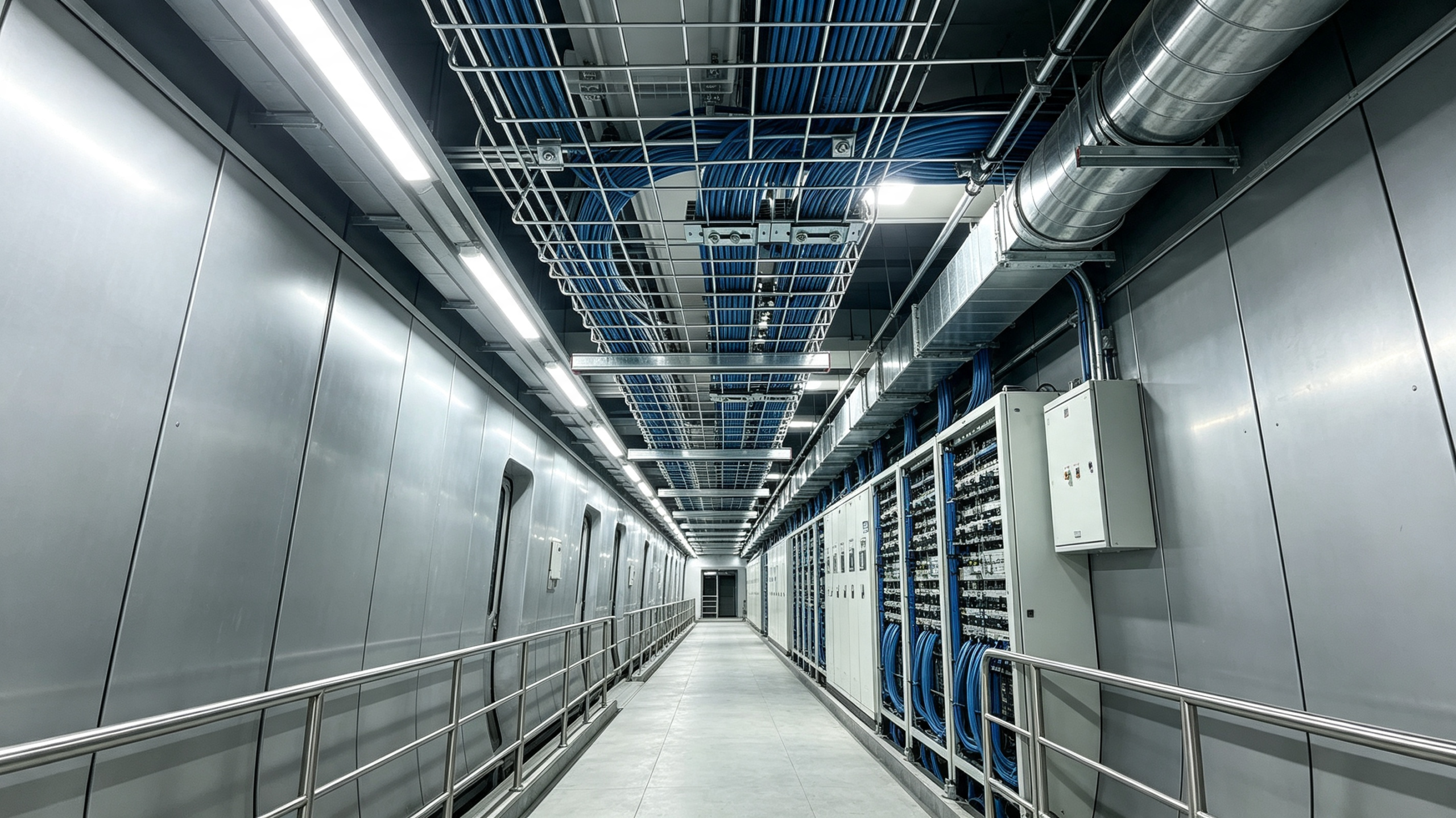
Project Overview & On-Site Cabling Challenges
This project serves a comprehensive industrial park integrating Tier 3 data center, automated manufacturing workshops, administrative office buildings and underground utility corridors. The site features mixed power and network cabling, 24/7 continuous equipment operation and high humidity in enclosed pipeline areas. The original conventional cable tray system created multiple operational bottlenecks that affected safety, efficiency and daily maintenance.
Excessive heat buildup in dense data center cabling zones
Thousands of power cables, fiber optic lines and network cables are densely arranged in the server room ceiling and equipment zones. Traditional closed trays block natural air circulation, resulting in sustained heat accumulation. Long-term high-temperature operation caused unstable signal transmission, increased cable power loss and raised potential fire risks. It also forced the cooling system to run at full load, bringing unnecessary energy waste.
Inflexible tray structure restricts production iteration
The automated workshop updates production equipment and process layouts every 3 to 6 months. The original fixed welded cable trays required cutting, drilling and re-welding for any route adjustment. This cumbersome modification process halted on-site production, delayed project schedules and left irregular, unstandardized cabling layouts after each renovation.
Blind tray coverage slows down fault troubleshooting
Fully enclosed tray covers hid internal cable conditions completely. Minor issues including loose connections, slight insulation wear and messy cable stacking could not be detected during daily inspections. Most circuit faults required extensive disassembly of tray covers, extending system downtime and increasing maintenance labor costs.
Humid corridor environment triggers corrosion and deformation
The underground pipe corridor and semi-outdoor transition areas maintain high humidity year-round with frequent condensation. Ordinary thin galvanized trays suffered from rust spots, structural deformation and loose welding joints after long-term erosion. Corroded sharp edges easily scratched cable insulation, while deformed trays lost standard load-bearing capacity, creating major electrical safety hazards.
BDCABLETRAY Customized Wire Mesh Cable Tray Solution
After comprehensive on-site investigation, environment evaluation and demand communication, the BDCABLETRAY engineering team abandoned the original unified rigid tray layout. We adopted a zoning matching wire mesh cable tray solution with differentiated materials, surface treatments and modular structures. The customized design targets heat dissipation, flexible adjustment, visual maintenance and anti-corrosion performance to fully resolve on-site cabling problems.
Open mesh structure eliminates heat accumulation dead zones
Different from closed tray products, BDCABLETRAY wire mesh cable trays adopt a full open grid structure with 360° free air convection. Heat generated by high-density operating cables dissipates instantly without local accumulation. This design effectively lowers cable operating temperature, slows down insulation aging and stabilizes data and power transmission quality. It also reduces data center cooling load, helping facilities cut long-term energy consumption.
Full modular bolt assembly enables flexible layout adjustment
The entire mesh tray system adopts standardized modular components with pure bolted connection, requiring no on-site welding or painting. Construction teams can freely cut, splice, extend and redirect trays according to actual wiring routes. When the workshop upgrades equipment or adjusts production lines, the trays can be disassembled, rearranged and reused completely. This modular feature drastically shortens renovation time and avoids material waste and production suspension losses.
Zoned anti-corrosion treatment adapts diverse environments
To balance performance and cost efficiency, we implemented graded material configuration for different zones. Dry indoor areas including data centers and office buildings use hot-dip galvanized wire mesh trays with reliable basic anti-rust performance. Humid underground corridors and semi-outdoor sections adopt premium 304 stainless steel mesh trays. Zoned matching prevents insufficient protection in harsh environments and avoids over-engineering for regular areas.
Transparent grid design improves daily maintenance efficiency
The intuitive mesh structure exposes all internal cables completely. Maintenance staff can inspect cable aging, stacking conditions and load abnormalities without disassembling any parts. Potential faults can be identified and handled early, greatly improving troubleshooting speed and reducing unexpected system downtime.
Lightweight high-strength structure reduces building load
Under equivalent load-bearing standards, wire mesh trays are significantly lighter than traditional solid steel trays. The optimized lightweight structure reduces pressure on ceiling suspenders and corridor support frames, improving the overall safety margin of the building’s electromechanical system, especially suitable for large-area overhead laying scenarios.
Measurable Post-Project Operation Results
After full installation, cable sorting and system commissioning, the park’s cabling system has operated stably for over 12 months. All historical pain points are completely resolved, with obvious improvements in safety, efficiency and cost control.
In terms of thermal management, the open convection design eliminates cable overheating issues. The data center’s internal cabling temperature remains stable, signal fluctuation faults drop to zero, and the average service life of core cables is effectively extended.
In terms of construction and renovation efficiency, the modular structure increases wiring adjustment efficiency by more than 50%. The park no longer needs large-scale construction shutdowns for production upgrades, saving substantial annual maintenance and renovation costs.
In terms of environmental adaptability, zoned anti-corrosion trays remain rust-free and structurally stable in humid and semi-outdoor environments. The overall cabling layout is neat and standardized, successfully passing multiple safety audits and official project acceptance.
Common Application Scenarios for BDCABLETRAY Wire Mesh Trays
Data centers and server rooms
Ideal for high-density mixed laying of power cables and optical fibers. Superior ventilation performance prevents heat accumulation and ensures 24-hour stable operation of server and network systems.
Smart automated manufacturing workshops
Perfect for production lines with frequent process upgrades and equipment replacement. Reusable modular structure adapts dynamic layout adjustments and reduces long-term infrastructure investment.
Commercial buildings and office weak-current systems
Suitable for ceiling network cabling and weak-current wiring. Transparent layout standardizes building electrical management and simplifies daily inspection work.
Underground corridors and high-humidity industrial zones
Custom stainless steel and enhanced anti-corrosion mesh trays adapt to humid, dusty and slightly corrosive environments, featuring low maintenance and long service life.
Key Advantages of BDCABLETRAY Wire Mesh Cable Tray Solutions
360° open ventilation reduces operational risks
Eliminates heat dissipation dead angles inherent in closed trays, effectively lowering cable aging speed and reducing fire hazards, improving the overall safety level of electromechanical systems.
Reusable modular design cuts project costs
Free disassembly and recombination eliminate repeated procurement and construction needs. The flexible structure matches modern factory and data center dynamic operation modes, bringing long-term cost advantages.
Visual layout simplifies facility management
Real-time visible cable status realizes refined inspection and quick fault location, avoiding hidden dangers caused by blind maintenance and improving overall operational controllability.
Multi-spec customization fits complex working conditions
Multiple material grades, wire diameters, mesh sizes and surface treatment processes support targeted customization for dry, humid, indoor and outdoor scenarios, ensuring stable product performance in diverse environments.
If you need high-ventilation, low-maintenance and flexible cable tray solutions for data centers, smart factories and commercial construction projects, contact BDCABLETRAY. Our professional engineering team provides free on-site evaluation, customized scheme design and full-process technical guidance to create a safe and efficient cable management system for your project.
FAQ
1. What are the actual advantages of wire mesh cable trays over traditional ladder and solid trays?
Wire mesh cable trays stand out in three core aspects: full open ventilation to avoid cable overheating, modular assembly for flexible layout adjustment, and transparent structure for convenient daily maintenance. Unlike rigid traditional trays that are hard to modify and trap heat, mesh trays perfectly fit modern high-standard data centers and dynamic industrial production scenarios.
2. Can wire mesh cable trays support heavy-duty industrial high-load cabling?
Yes. BDCABLETRAY wire mesh trays adopt thickened steel wire and reinforced welding craftsmanship. Despite the lightweight appearance, the overall structural stability and load-bearing capacity fully meet high-power cable bundle laying standards. The open structure also solves the overheating problem of high-load cables, which is a unique advantage over ordinary trays.
3. Are wire mesh cable trays durable enough for humid and corrosive environments?
Absolutely. BDCABLETRAY provides multiple anti-corrosion solutions including hot-dip galvanizing, electrostatic powder coating and 304 stainless steel. Targeted surface treatments effectively resist humidity, condensation and mild chemical corrosion. Customized products can maintain stable performance for years in underground corridors, coastal humid areas and industrial workshops.
4. Does wire mesh cable tray installation take more time than traditional trays?
No, installation efficiency is much higher. The modular bolt-on structure requires no on-site welding, polishing or painting. The lightweight components are easy to carry and splice, supporting flexible cutting according to site routes. It greatly shortens construction cycles and is more friendly for large-scale renovation projects.
5. Can BDCABLETRAY provide fully customized wire mesh cable tray solutions?
Yes. BDCABLETRAY supports one-stop personalized customization, including tray width, height, wire diameter, mesh spacing and surface technology. Our engineers adjust product parameters and structural designs according to your project’s wiring density, environmental conditions and safety standards to achieve the best on-site matching effect.