



Last winter we took on an RFQ from a meat processing and packaging plant in Victoria, Australia. The customer was retrofitting a new high-speed packaging line and needed to route power, ethernet and sanitary-grade instrumentation cabling through 1,800 meters of existing ceiling and wall space. The catch: the whole area gets hosed down with hot water and food-safe detergent every shift end, and the local food safety auditor would not certify anything that trapped water or harbored bacteria.
The customer had originally specified solid-bottom galvanized tray, which is cheap and common. Our engineer pushed back after a 30-minute video walkthrough of the line. We proposed open wire mesh in 304 stainless steel instead. This case is the result — the layout we confirmed, the product we shipped, and how it performed after three months of wash-down cycles.
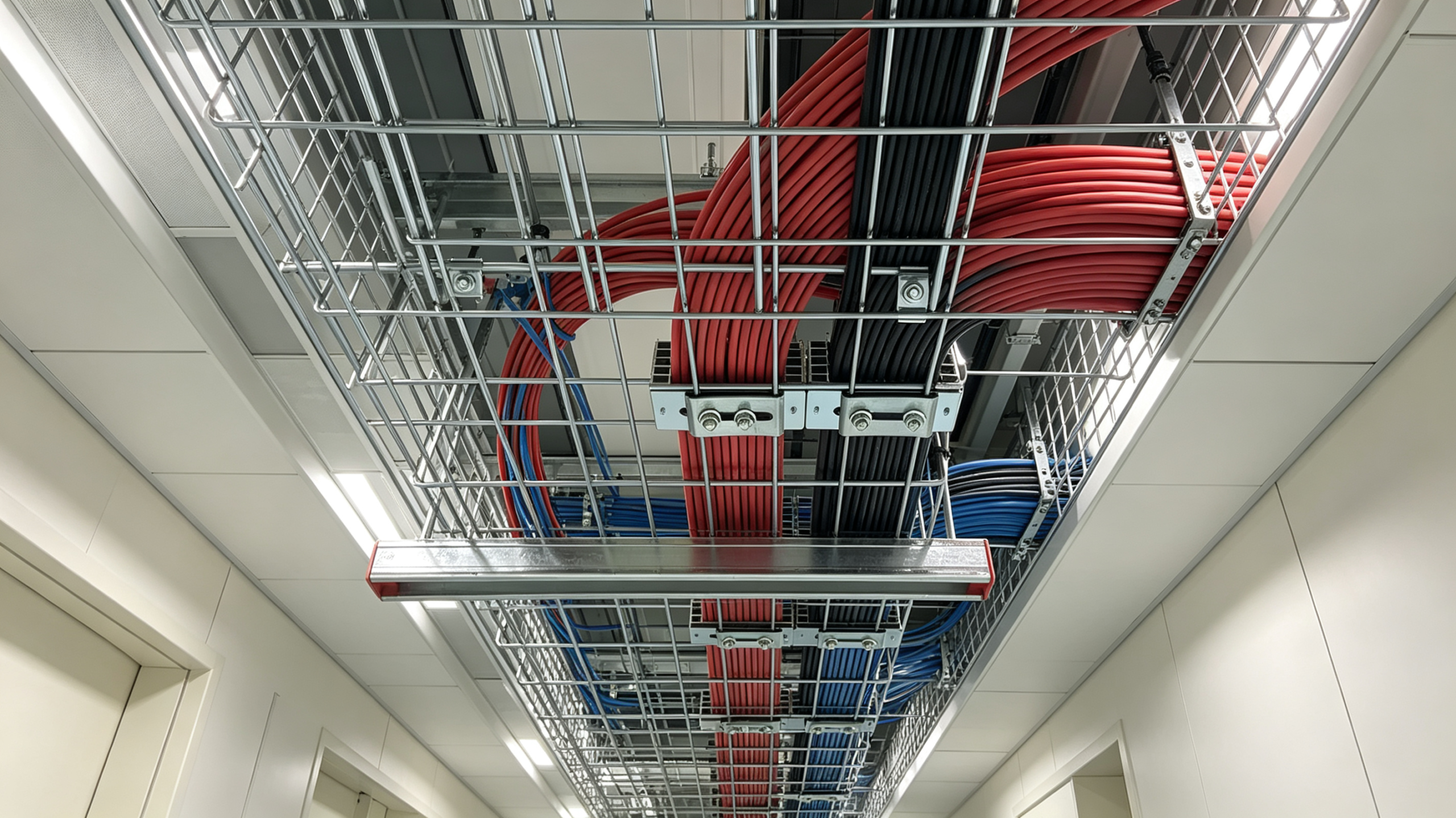
Why Wire Mesh Won Over Solid Bottom Tray
Food and beverage environments are unforgiving on cable management. The customer’s existing galvanized trays in the older wing had developed rust streaks where water sat on the flat bottom, and the corners held dust and product residue. A second identical installation would have failed the next audit.
Drainage and wash-down compatibility
Open wire mesh has no flat surface to hold water. When the floor crew hoses the overhead cable run after the shift, water falls straight through the grid instead of pooling on the tray bottom. There are also no enclosed corners for product debris to settle, which is exactly what the food safety auditor wanted to see.
Heat dissipation for variable-frequency drive cables
The new packaging line runs multiple variable-frequency drives (VFDs) on the conveyor motors. VFD output cables run hotter than standard power because of harmonic content. Solid-bottom trays can trap that heat against the cable jacket. The open mesh lets air circulate on all sides, which the customer’s electrical engineer confirmed was the deciding technical point for switching.
Flexibility around existing equipment
The ceiling area above the processing line is crowded with refrigeration pipe, sprinklers and stainless ductwork. Wire mesh bends, cuts and extends on site much faster than solid steel troughs. The installer could drop new drops for sensors and cameras without ordering custom fittings — they clipped a short section of mesh straight off the roll stock we supplied.
Specs We Supplied
After two site walkthroughs and a drawing revision, we locked the following BOM. These are the actual dimensions shipped, not a marketing spec.
Main run trays
The main processing line used 300 mm wide × 100 mm high 304 stainless steel wire mesh tray, wire diameter 4 mm × 4 mm, mesh opening 50 × 100 mm. Total length on the main run was 1,200 meters. The lower-amp instrument and ethernet runs used 100 mm × 50 mm mesh, another 600 meters. All tray sections came in standard 3-meter lengths with pre-welded joining plates.
Support and suspension system
Because the ceiling structure was existing, we supplied galvanized steel trapeze hangers with threaded rod every 1.5 meters, rated for 50 kg per support point. At the wall entries we supplied stainless wall brackets and conduit transitions. No carbon steel parts touch the wash-down zone — every visible bracket in the wet area is 304 stainless.
Covers, drops and accessories
Over the VFD feeder cables we supplied removable stainless sheet covers to protect cable jackets from direct spray. For the sensor drops we supplied pre-formed 90-degree mesh elbows, T-pieces and reducing couplers, all in matching 304. The kit also included stainless tie wraps and labels for circuit identification at every panel entry.
Production and Shipping
The customer had a strict production shutdown window: 11 days between batches. We packed the order by line number — each pallet labeled Line 1 through Line 4 — and included a printed layout drawing taped to the first pallet so the local installer could cross-reference.
Material and finish verification
Before packing, our QC team ran a spot check on the stainless: a pass/fail spectro reading on random wire samples to confirm 304 grade, and a visual check that all welds were ground smooth with no sharp burrs. The customer brought their own third-party inspector on day two of production, who signed off on the material certs we provided.
Loading and documentation
Because mesh tray is light but bulky, we loaded the 1,800 meters into a 20GP container with the accessories and cover sheets on the top layer. Total weight came in at 2.1 tons, well under the road limit for Australian import. We supplied the commercial invoice, packing list, material mill certs and the Australian customs declaration docs ready to forward to the customer’s broker.
How the Installation Went
The customer used their own in-house electrical crew, with our engineer on video support for the first two days. They started at the distribution panel and worked outward along the ceiling grid. The mesh sections clicked together with the supplied couplers; the crew reported that the on-site modifications — shortening a tray, bending a drop, notching around a sprinkler — took about a third of the time they expected based on past solid-tray jobs.
Wash-down testing started on day nine, one day ahead of the restart schedule. The food safety auditor walked the line the next morning and flagged no corrosion, pooling or residue issues. The plant restarted on day 11 as planned.
What the Customer Says After 90 Days
We checked in after the first quarterly audit. The auditor signed off the cable management without a single observation. The maintenance team reports that adding a new sensor or camera drop now takes under an hour, because they simply clip a short mesh section off the spare length we left them on site.
The customer has already asked us to quote the next processing wing on the same line, specifying 304 stainless mesh with the same 300 × 100 main size. Standardizing across the plant means they now keep one SKU family on the shelf.
If you are planning a cable tray run in a wash-down, hygienic or food-safe environment — or any project where corrosion, heat dissipation or fast on-site modification matters — contact BDCABLETRAY. Send us your cable schedule, environment conditions and country of destination, and we will come back with a BOM, material grade recommendation and a fixed quote within one working day.
FAQ
1. Is 304 stainless steel wire mesh tray enough for a food processing wash-down area?
304 works for most indoor food and beverage environments with regular wash-down. If your line uses high-chloride cleaning chemicals or sits on a coastal site, we recommend upgrading to 316L stainless for the wet-zone sections. We can mix grades in one order — 304 for dry zones, 316 for wet zones — to balance cost and performance.
2. How much does stainless steel wire mesh tray cost compared to galvanized solid bottom?
Stainless mesh usually runs 30–60% higher than galvanized solid bottom on a per-meter basis, depending on width and wire gauge. In wash-down environments the galvanized option fails within 1–3 years, so the stainless option is cheaper over the life of the plant. We can run a side-by-side landed cost comparison for your specific run length on request.
3. Can you supply the tray already cut to our lengths?
Standard sections ship in 3-meter lengths. We can cut to custom lengths at the factory, but most customers prefer the standard length and cut on site — mesh is easy to trim with bolt cutters and the installer adjusts on the ladder. We will note the trade-off on your quote.
4. What is the lead time for stainless wire mesh tray orders?
Standard 304 mesh in common widths ships in 10–15 working days after order confirmation. 316 material and non-standard widths add 5–10 days. We will hold the most common sizes in stock for repeat customers so reorders ship within a week.
5. Do you provide load ratings and installation drawings?
Yes. Every quote comes with a span-and-load table for the selected width and wire gauge, and we supply general arrangement drawings showing support spacing and drop points once your electrical drawings are locked in. We can also provide 3D models for your BIM team if needed.