



Modern data centers, intelligent office buildings and automated industrial workshops have unique cabling demands that traditional solid and ladder cable trays cannot fully meet. These scenarios feature dense power cables, a large number of network fiber lines, long-term continuous equipment operation and frequent wiring adjustment and expansion. Closed cable trays easily cause heat accumulation, leading to cable overheating and signal instability, while rigid tray structures bring huge inconvenience for later line inspection, maintenance and upgrading.
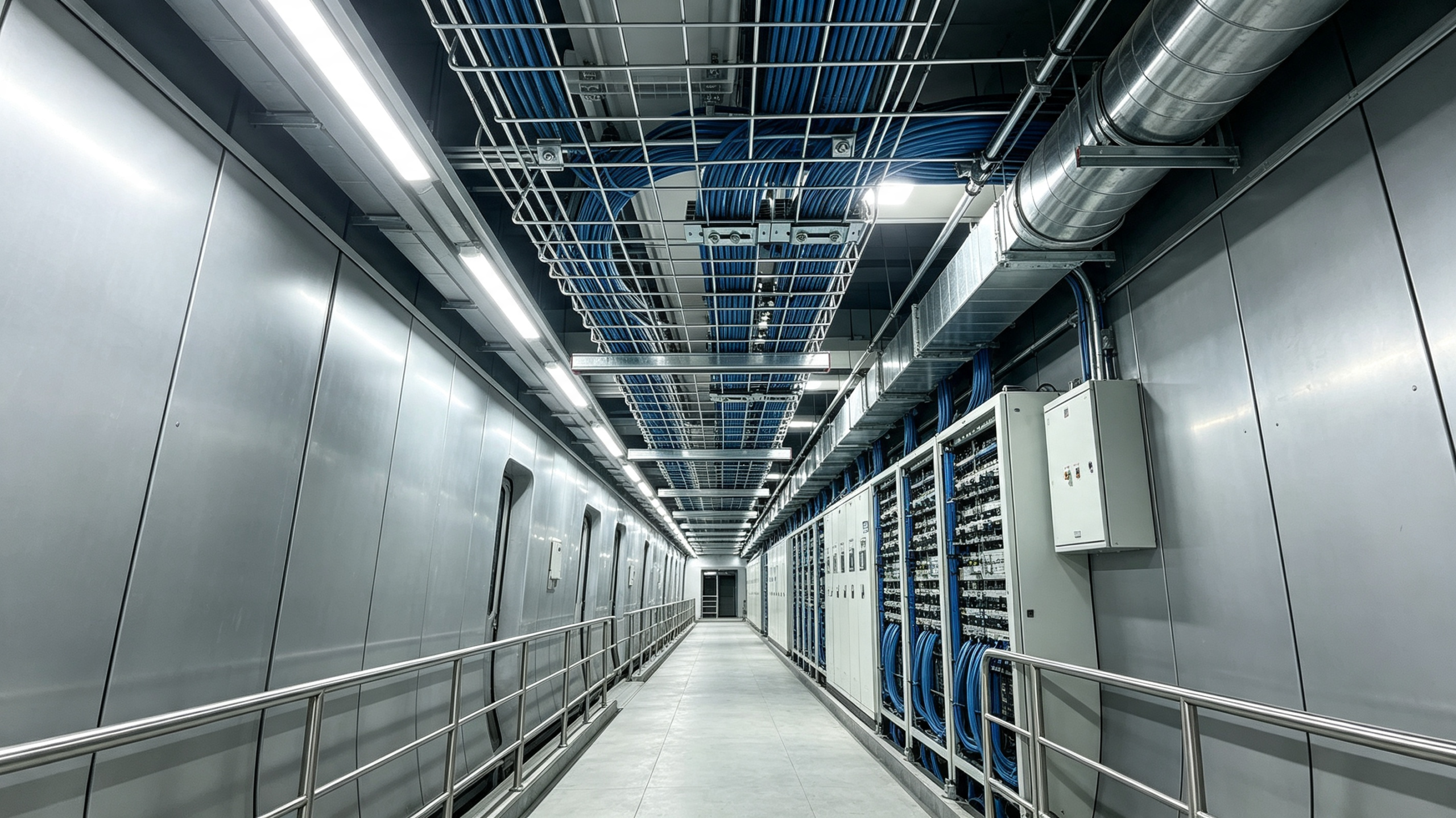
Wire mesh cable trays stand out in lightweight, high ventilation and flexible installation, becoming the mainstream choice for new-generation intelligent building cabling systems. BDCABLETRAY recently completed a large-scale cabling renovation project for a regional cloud data center, solving the problems of poor heat dissipation, difficult maintenance and messy wiring of the original system. This real engineering case shares the project pain points, customized mesh tray solutions and practical operation effects, providing reliable reference for similar intelligent facility cabling projects.
Project Background & Original Cabling System Defects
The client is a professional cloud computing data center, undertaking server storage, network transmission and enterprise cloud service business. The equipment room runs 24/7 all year round, with intensive power distribution lines and optical fiber signal lines. The original project adopted traditional perforated cable trays, which exposed many bottlenecks restricting stable equipment operation and daily maintenance after two years of operation.
Poor heat dissipation leads to continuous high cable temperature
The semi-closed structure of perforated trays has limited air circulation efficiency. A large number of densely arranged power and signal cables generate continuous heat during long-term operation. The heat cannot be discharged in time, resulting in long-term high temperature of cable lines. This not only increases network signal delay and power loss, but also accelerates cable insulation aging, greatly shortening the service life of expensive server supporting lines.
Difficult daily inspection and line troubleshooting
The traditional tray structure covers the upper and lower parts of cables. Operation and maintenance personnel cannot directly observe cable aging, joint looseness and line damage during daily patrols. Once network failure or circuit abnormality occurs, the maintenance team needs to spend a lot of time disassembling trays and sorting out lines, resulting in long fault recovery time and affecting data center stable service output.
Inflexible structure unable to adapt to frequent upgrading
The data center needs to continuously add server equipment and expand network lines according to business growth. The original fixed tray layout is rigid, and secondary drilling and cutting are required for each line expansion. The construction process is cumbersome, easy to damage original wiring, and cannot adapt to the rapid iteration needs of cloud data center business.
Dust accumulation affects equipment operating environment
The closed tray structure is easy to accumulate dust for a long time, and the internal dust is difficult to clean. Excessive dust accumulation not only affects cable heat dissipation, but also may cause static interference, bringing hidden dangers to the stable operation of precision network equipment.
BDCABLETRAY Custom Wire Mesh Cable Tray Solution
Combined with the data center’s 24-hour continuous operation, dense wiring and frequent upgrading characteristics, BDCABLETRAY completely replaced the original perforated trays with customized hot-dip galvanized wire mesh cable trays. Adopting full open grid structure and modular assembly design, we thoroughly solved the four major pain points of poor heat dissipation, difficult maintenance, inflexible upgrading and dust accumulation of the original system.
Full open grid structure for 360° heat dissipation
BDCABLETRAY wire mesh cable tray adopts three-dimensional hollow grid weaving structure, with almost no shielding dead corners. It realizes full-range air convection around the cables, quickly takes away the heat generated by long-term operation of power and signal lines, effectively reduces cable operating temperature, avoids signal instability and line aging caused by overheating, and ensures low-delay and stable operation of data center network lines.
Visual grid design for zero-dead-angle maintenance
The transparent mesh structure fully exposes all laid cables and optical fibers. Operation and maintenance personnel can directly check cable appearance, joint status and line arrangement during daily patrols without disassembling any trays. Hidden faults such as aging, damage and loose joints can be found and eliminated at the first time, greatly improving the efficiency of daily inspection and emergency troubleshooting.
Modular flexible assembly for rapid expansion
All wire mesh trays adopt standardized modular design, with flexible splicing and free cutting. No professional welding and drilling construction is required for installation and later line expansion. When the data center adds servers and expands business lines, the mesh tray can be freely extended and adjusted according to the new wiring path, which is fast and convenient, and will not damage the original cabling system, perfectly adapting to the rapid iteration of data center business.
Anti-corrosion & dust self-cleaning optimized design
The tray overall adopts high-standard hot-dip galvanized surface treatment, with dense surface protective layer, excellent anti-oxidation and anti-corrosion performance, suitable for long-term indoor constant temperature operation environment. Meanwhile, the open grid structure is not easy to accumulate dust, and the surface can be cleaned quickly with daily dust removal equipment, maintaining a clean and tidy wiring environment and avoiding static interference caused by dust accumulation.
Lightweight structure reduces building load
Compared with traditional steel trays of the same specification, wire mesh trays are lighter in overall weight, which greatly reduces the load pressure on the overhead ceiling and support frame of the equipment room. It avoids potential structural hazards caused by long-term heavy load and ensures the long-term safe operation of the equipment room facility.
Post-Project Operation Effects & Optimization Results
After the full replacement and installation of BDCABLETRAY wire mesh cable trays, the client’s data center cabling system achieved comprehensive upgrading. After 18 months of stable operation, all operating indicators have been significantly optimized, and the on-site use feedback is excellent.
In terms of heat dissipation optimization, the 360° open ventilation structure effectively reduces the overall operating temperature of cables, the line overheating failure rate is reduced by more than 80%, the network signal transmission is more stable, and the equipment power consumption is significantly reduced.
In terms of operation and maintenance efficiency, the visual mesh structure realizes intuitive line inspection. The daily patrol efficiency is improved by more than double, and the fault processing time is shortened by 70%, effectively ensuring the continuity and stability of data center business services.
In terms of business expansion, the flexible modular structure supports rapid line upgrading and layout adjustment. The later equipment expansion and wiring renovation cycle is greatly shortened, no repeated investment and construction waste are generated, and the long-term comprehensive operation cost is effectively saved.
Main Application Scenarios of BDCABLETRAY Wire Mesh Cable Tray
Data center & server equipment room
Suitable for intensive power and network wiring of cloud data centers, computer rooms and server rooms, meeting high heat dissipation and frequent line expansion needs.
Smart building & office automation system
Ideal for intelligent office buildings, commercial complexes and building automation wiring, with neat layout and convenient later maintenance and upgrading.
Electronics & precision manufacturing workshop
Applicable for precision electronic workshops and automated production lines, avoiding heat accumulation and static interference, ensuring stable operation of precision equipment.
Low-corrosion indoor industrial facility
Widely used for indoor workshop power distribution and signal wiring of light industrial factories, with low maintenance and long service life.

Core Advantages of BDCABLETRAY Wire Mesh Cable Tray
360° ultra-high ventilation to avoid cable overheating
The fully open grid structure has no ventilation dead corners, realizing omnidirectional air convection. It solves the overheating problem of dense wiring, stabilizes signal transmission and effectively delays cable aging.
Visual layout for low-cost efficient maintenance
Transparent mesh design makes all cables clearly visible. Operation and maintenance personnel can quickly inspect and troubleshoot without disassembling trays, greatly reducing daily maintenance time and labor costs.
Modular flexibility for free layout adjustment
Standardized modular assembly structure supports arbitrary splicing, cutting and extension. It adapts to frequent line upgrading and layout changes of intelligent facilities, with zero damage to original projects.
Lightweight & durable with low comprehensive cost
Lightweight structure reduces building load pressure. With high-standard anti-corrosion treatment, it has stable performance and long service life. The flexible and reusable design avoids repeated procurement and construction costs, with outstanding long-term cost performance.
If you need high-ventilation, easy-maintenance and flexible wire mesh cable tray solutions for data centers, smart buildings and precision manufacturing projects,contact BDCABLETRAY. Our professional engineering team provides free on-site survey, customized wiring scheme design and full-process installation guidance to help you build efficient, stable and low-maintenance intelligent cabling systems.
FAQ
1. What are the biggest advantages of wire mesh cable trays compared with traditional trays?
Wire mesh cable trays feature fully open ventilation structure, visual wiring layout and flexible modular assembly. Compared with closed and perforated trays, they have better heat dissipation effect, more convenient daily maintenance, and can adapt to frequent line expansion and layout adjustment, which is more suitable for modern intelligent facility cabling scenarios.
2. Is wire mesh cable tray strong enough for dense cable laying?
Yes. BDCABLETRAY wire mesh cable trays adopt high-strength steel wire integral welding and reinforced weaving process. The overall structure is stable and firm, with uniform load-bearing performance. It can fully meet the load-bearing requirements of dense power cables and optical fiber lines in data centers and ordinary industrial scenarios, and will not deform or sag after long-term use.
3. Are wire mesh cable trays suitable for outdoor and corrosive environments?
Conventional galvanized mesh trays are mainly suitable for indoor dry environments. For outdoor humid, salt spray and slightly corrosive scenarios, BDCABLETRAY can provide customized stainless steel 304/316 wire mesh trays or composite anti-corrosion treated mesh trays to adapt to harsh environmental conditions.
4. Does open mesh tray wiring affect cable safety and stability?
No. The standardized grid spacing and reinforced edge structure of BDCABLETRAY wire mesh trays can stably fix all cables and optical fibers, avoiding line displacement and falling caused by equipment vibration. The open structure will not affect wiring safety, but effectively eliminate hidden dangers of cable overheating and static interference.
5. Is wire mesh cable tray more cost-effective for long-term project operation?
Absolutely. Although the initial procurement cost is equivalent to traditional trays, wire mesh trays greatly reduce daily maintenance workload and fault loss. The reusable modular structure avoids repeated renovation investment caused by line upgrading. The long-term comprehensive operation and maintenance cost is far lower than traditional closed cable trays.