



Modern data centers, intelligent machine rooms and high-end commercial buildings feature dense weak-current cables, frequent wiring adjustments and strict heat dissipation requirements. Traditional solid and ladder cable trays often face obvious limitations in these scenarios: closed structures cause poor ventilation, rigid frameworks fail to adapt to complex curve wiring, and later cable modification and maintenance consume massive manpower and time.
As an open, flexible and easy-to-install cabling carrier, wire mesh cable trays (also known as basket cable trays) have become the preferred solution for low-voltage and weak-current wiring projects in recent years. BDCABLETRAY recently completed a large-scale wire mesh cable tray renovation and new construction project for a comprehensive commercial office building and supporting data center. This case fully solves the pain points of poor heat dissipation, difficult layout adjustment and troublesome maintenance of traditional trays, and delivers stable and compliant wiring effects. This article shares the complete project background, customized solutions and practical application results.
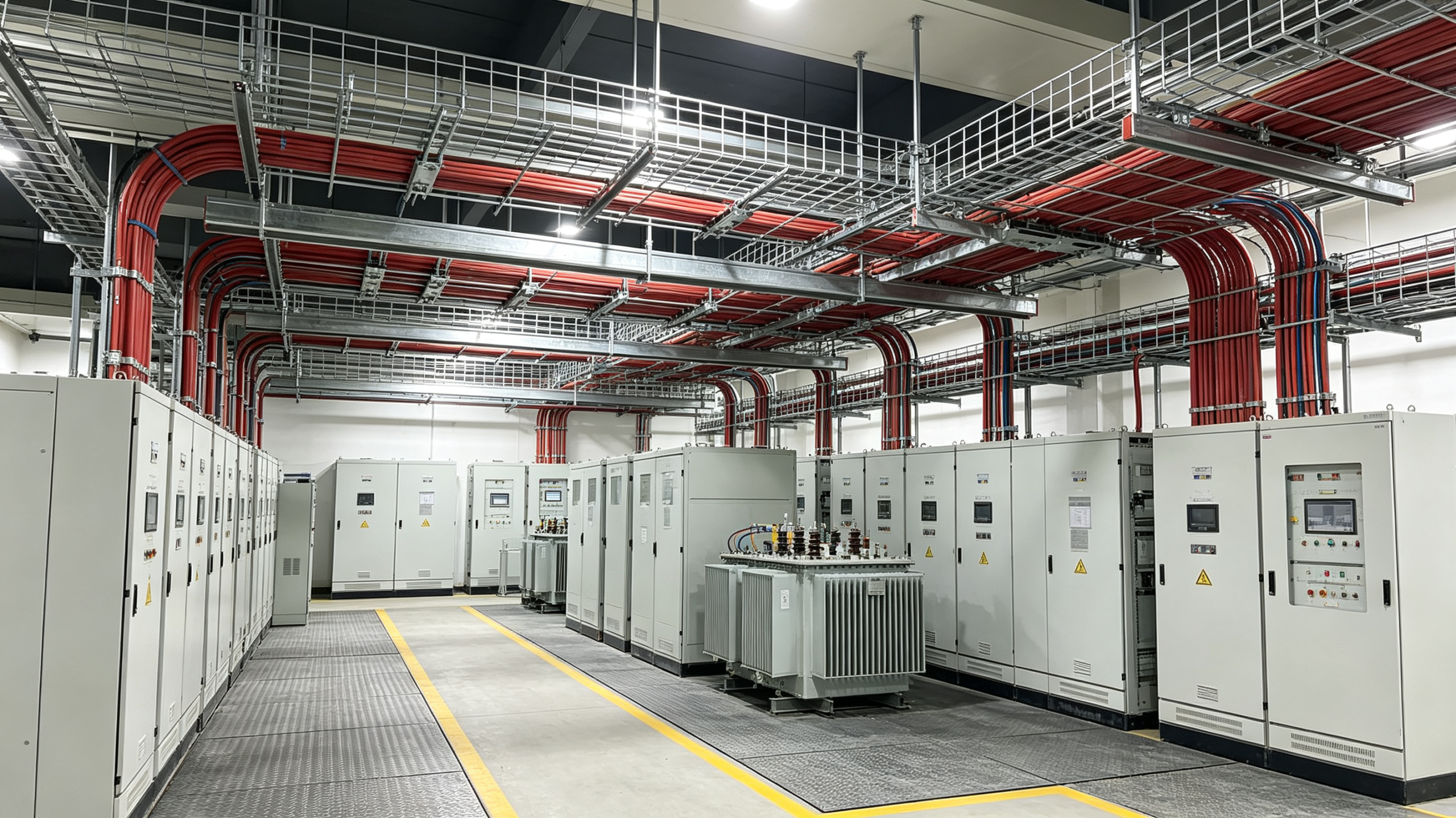
Project Background & On-Site Wiring Challenges
This project covers a 22-story high-end commercial office building and a supporting central data center, involving building intelligent control systems, network communication wiring, security monitoring circuits and weak-current power distribution systems. The original design adopted partial ladder trays and traditional grooved trays. During the construction preparation stage, the engineering team found multiple hidden troubles that could not meet the long-term operation and maintenance needs of intelligent buildings.
Insufficient Heat Dissipation for Dense Weak-Current Cables
The data center and machine room are equipped with a large number of network cables, optical fibers and control wires, which run continuously all year round. Traditional closed trays easily form heat accumulation. Long-term high temperature will reduce network signal stability, accelerate cable insulation aging, and even cause local signal interruption, affecting the normal operation of building intelligent systems.
Rigid Structure Unable to Adapt to Complex Ceiling Layout
The building ceiling is equipped with a large number of ventilation pipes, fire-fighting pipelines and electrical pipelines, with complex crossing structures and many curved and narrow wiring spaces. Traditional rigid cable trays are difficult to bend and adjust, requiring a large number of customized elbows and tees, resulting in complicated construction and prolonged project cycle.
Difficult Later Cable Adjustment & Maintenance
Office building functional zones need regular adjustment and upgrading of network and monitoring systems. Traditional tray wiring is fixed and enclosed. Adding, replacing or migrating cables requires dismantling partial tray structures, which is time-consuming and laborious, and greatly increases later operation and maintenance costs.
Dust Accumulation Affects Long-Term Operational Safety
Closed tray structures are prone to internal dust accumulation, which cannot be cleaned in daily inspection. Excessive dust will affect cable heat dissipation and even cause short-circuit risks, failing to meet the clean and safe operation standards of data center machine rooms.
BDCABLETRAY Custom Wire Mesh Cable Tray Solution
Combined with the project’s characteristics of dense weak-current wiring, complex space layout and frequent later upgrading, BDCABLETRAY completely replaced traditional trays with standardized hot-dip galvanized wire mesh cable trays. We formulated targeted segmented wiring and flexible layout schemes to adapt to different functional areas, realizing efficient construction, excellent heat dissipation and convenient later maintenance.
Full Open Mesh Structure for 360° Ventilation
Different from closed and ladder trays, BDCABLETRAY wire mesh trays adopt fully open grid design with no shielding dead corners. The 360° hollow structure forms continuous air convection around the cables, effectively taking away operating heat. It completely solves the heat accumulation problem of dense network cables and optical fibers, maintains stable cable temperature, and ensures zero signal delay and interruption in long-term operation of data center equipment.
Flexible Bending & Free Combination Layout
The wire mesh tray features soft structural flexibility and strong adaptability. It can be bent and adjusted freely according to on-site ceiling pipelines, curved walls and narrow gaps without a large number of customized accessories. The modular splicing design realizes quick lap jointing of straight sections, curves and crossing positions, greatly simplifying complex wiring construction and shortening the overall construction cycle.
Tool-Free Quick Installation Process
BDCABLETRAY optimized the connection accessories of wire mesh trays, adopting snap-on fast assembly structure. The whole installation process requires no professional welding and complex drilling fixation. Ordinary construction workers can complete rapid splicing and fixing, effectively reducing labor costs and improving on-site construction efficiency.
Hot-Dip Galvanized Anti-Corrosion & Dust-Free Design
All wire mesh trays are treated with hot-dip galvanizing overall anti-corrosion process, with uniform zinc layer and strong oxidation resistance. It adapts to indoor constant temperature and humid environment of office buildings and machine rooms, avoiding rust and aging. Meanwhile, the open mesh structure is not easy to accumulate dust, and can be directly cleaned by wiping and blowing, meeting the high-cleanliness operation standards of data centers.
Visible Wiring for Convenient Daily Management
The fully open layout makes all internal cables clear at a glance. Maintenance personnel can directly observe cable aging, joint looseness and wiring confusion without disassembling any structure. It realizes rapid fault location and daily inspection, and supports free cable addition and migration for later system upgrading.
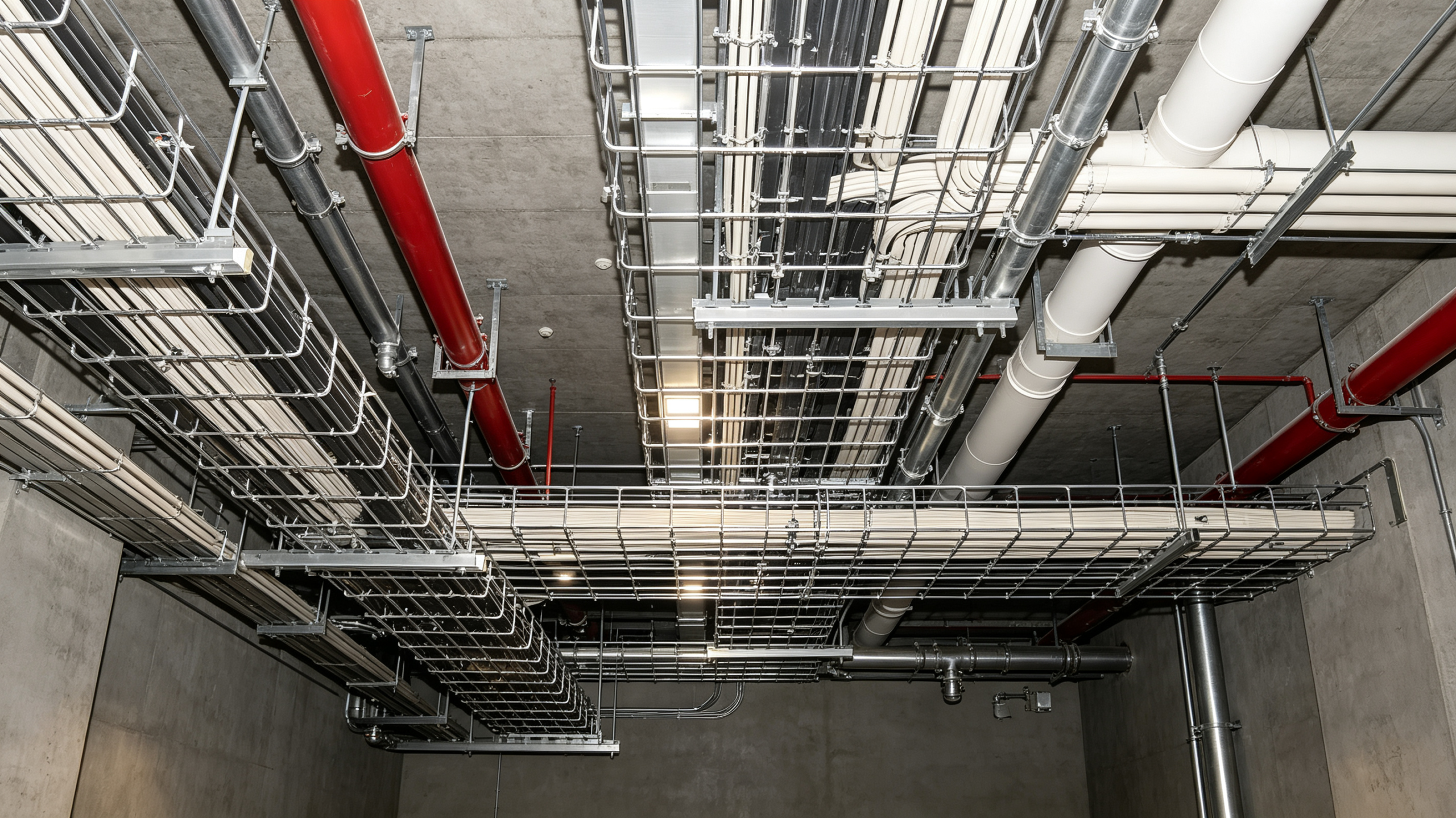
Post-Project Operation Effects & Advantages
After the completion of the wire mesh cable tray laying project, the building’s weak-current wiring and data center cabling system achieved comprehensive optimization. The open mesh structure completely solves the problem of cable heat accumulation, and the signal transmission stability of network and monitoring systems is significantly improved, with zero high-temperature failure records for 12 consecutive months.
The flexible layout perfectly fits the complex ceiling pipeline layout, making the overall wiring neat and standardized, and successfully passing the project safety acceptance and fire inspection. In the later stage of functional upgrading and cable adjustment, the maintenance efficiency is increased by more than 60%, avoiding a large number of disassembly and reconstruction work, and greatly saving the long-term operation cost of the building.
In addition, the galvanized anti-corrosion structure maintains a smooth and clean appearance for a long time, no dust accumulation and rust phenomenon, which not only ensures electrical safety, but also improves the overall refined construction grade of the project.
Core Application Scenarios of BDCABLETRAY Wire Mesh Cable Tray
Data Center & Server Machine Room
Suitable for dense network cables, optical fibers and weak-current control lines, relying on high ventilation performance to ensure stable operation of server equipment.
High-End Commercial Office Buildings
Adapt to building intelligent wiring, monitoring wiring and weak-current power distribution, facilitating frequent functional adjustment and system upgrading.
Clean Workshop & Pharmaceutical Industry
Open structure is not easy to accumulate dust, meeting the high-cleanliness wiring standards of pharmaceutical, food and electronic precision workshops.
Exhibition Halls & Temporary Engineering Projects
Flexible disassembly and repeated use characteristics are suitable for temporary wiring and frequent layout adjustment of exhibition venues and activity venues.
Product Competitive Advantages
Superior Heat Dissipation & Stable Signal Transmission
360° open hollow structure realizes full air convection, eliminates cable heat accumulation, avoids signal attenuation and equipment failure caused by high temperature, and ensures long-term stable operation of weak-current systems.
Flexible & Efficient On-Site Construction
Free bending and modular assembly adapt to various complex space layouts, reduce customized accessory costs, shorten construction cycle, and save engineering labor investment.
Easy Maintenance & Low Long-Term Cost
Visible wiring facilitates daily inspection and rapid fault handling, supports free cable expansion and adjustment, no repeated investment in reconstruction, and reduces enterprise operation and maintenance costs.
Anti-Corrosion & Long Service Life
Standard hot-dip galvanized process resists daily oxidation and humid environment erosion, with durable structure, no rust and no deformation, meeting long-term engineering use standards.
If you need high-ventilation, flexible and easy-maintenance wire mesh cable tray solutions for data centers, commercial buildings and clean workshop wiring projects, contact BDCABLETRAY. We provide free on-site layout design, personalized product selection and factory direct supply services to create safe, compliant and high-efficiency wiring systems for your engineering projects.
FAQ
1. What are the unique advantages of wire mesh cable trays compared with traditional trays?
Wire mesh cable trays adopt fully open mesh structure, featuring better heat dissipation, more flexible layout and lower maintenance cost. Different from rigid closed and ladder trays, they can be bent freely to adapt to complex spaces, support tool-free quick installation, and allow direct observation and adjustment of cables without disassembly. They are more suitable for weak-current and dense wiring scenarios that require frequent upgrading.
2. Are wire mesh cable trays suitable for data center wiring?
Absolutely yes. Data centers have dense network cables and high requirements for heat dissipation and signal stability. The open structure of wire mesh trays avoids heat accumulation and signal interference. Meanwhile, the visible wiring design facilitates daily equipment inspection and later cable expansion and adjustment, which is the most ideal wiring solution for modern data center machine rooms.
3. Do wire mesh cable trays have load-bearing safety risks?
No safety risk at all. BDCABLETRAY wire mesh cable trays adopt high-strength steel wire integral welding and professional galvanizing process. The overall structural stability is strong, with standard load-bearing capacity, fully meeting the laying requirements of weak-current cables such as network lines, optical fibers and control lines. It can operate stably for a long time without deformation or collapse.
4. Is wire mesh cable tray easy to accumulate dust and affect wiring safety?
Far less than traditional closed trays. The open grid structure has no closed dead corners for dust accumulation, and the surface is smooth after galvanizing treatment. Daily dust cleaning can be completed by simple blowing and wiping. It will not affect cable heat dissipation and insulation performance, and fully meets the cleanliness requirements of indoor and clean industrial scenarios.
5. Can BDCABLETRAY customize wire mesh cable trays for special projects?
Yes. BDCABLETRAY supports full personalized customization of wire mesh cable trays. We can adjust mesh density, wire diameter, tray width and surface treatment process according to project scenarios, cable quantity and load requirements. We also provide matching connecting accessories to adapt to complex commercial buildings, data centers and clean workshop engineering wiring needs.