



Modern data centers, commercial smart buildings and automated office spaces rely on high-density, frequently upgraded weak current and communication cabling systems. Many traditional cable management solutions struggle to adapt to these fast-changing scenarios. Closed channel trays trap heat and block airflow, ladder trays feature bulky structures that waste ceiling space, and rigid conduit piping makes cable adjustment and daily inspection extremely difficult. These outdated layouts often lead to poor heat dissipation, hidden wiring faults and high renovation costs in later operation.
Wire mesh cable trays, also known as basket cable trays, have become the preferred solution for modern light-duty and high-flexibility wiring projects. Featuring open grid structure, ultra-light weight, full visibility and tool-free flexible installation, they perfectly match the core demands of data center cabling, building intelligent system wiring and frequent circuit iteration. BDCABLETRAY specializes in customized wire mesh cable tray solutions for global high-standard commercial and IT engineering projects. This article shares a practical large-scale smart office and data center integrated cabling project, sorting out on-site pain points, customized solutions and long-term operational benefits.
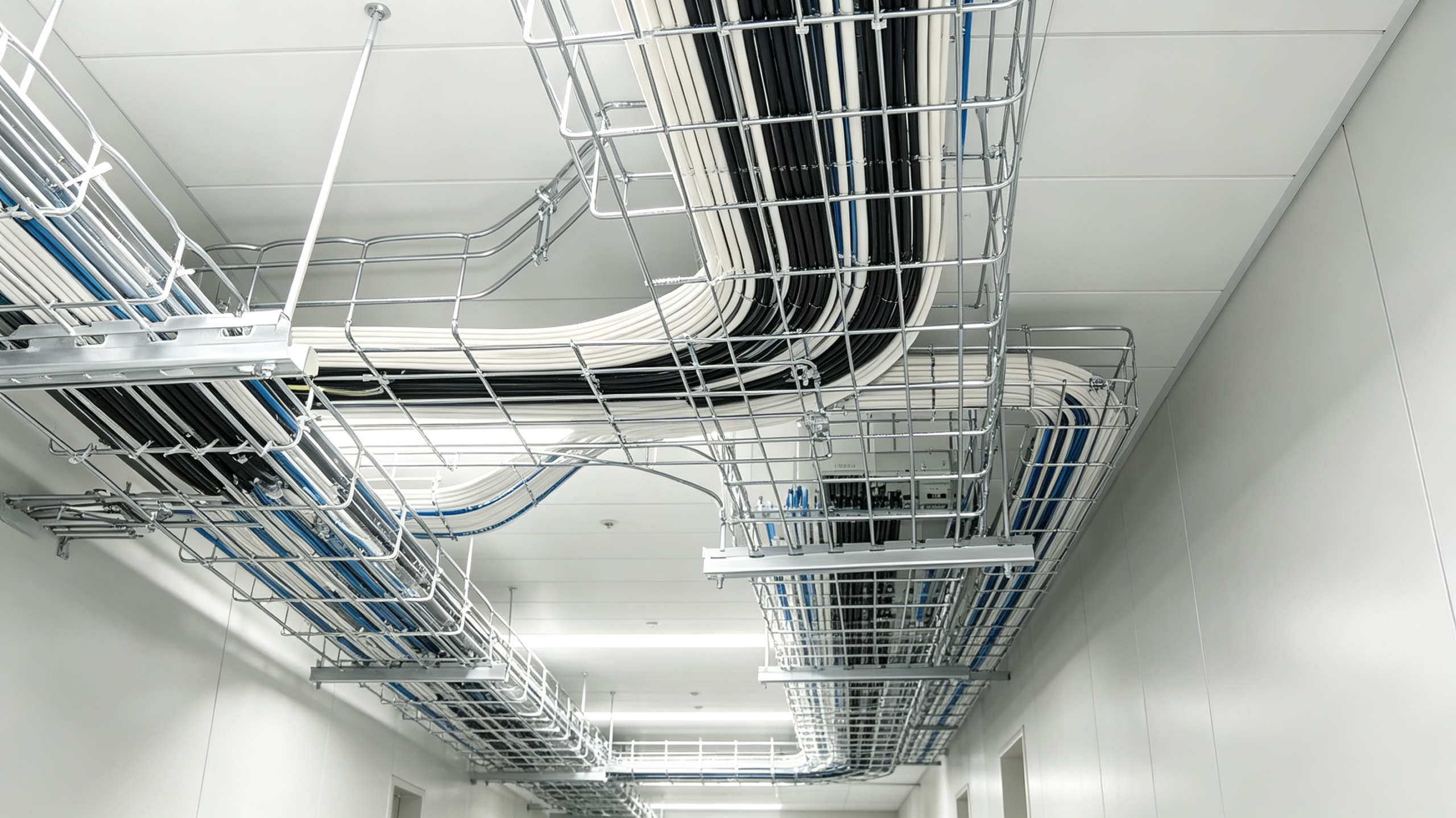
Project Background & On-Site Cabling Pain Points
This project is a comprehensive electrical and network cabling upgrade for a new ultra-modern smart office park in Southeast Asia. The park integrates office buildings, independent data machine rooms, intelligent access control systems and central air-conditioning automatic control systems. The whole site requires massive dense laying of network cables, signal lines, control cables and low-voltage power lines. The original reserved traditional tray scheme exposed multiple incompatible problems during the design stage.
Closed Tray Structure Causes Serious Heat Accumulation
Data center and intelligent building communication cables generate continuous heat during long-term high-frequency operation. Closed solid trays and dense perforated trays cannot form effective air convection. Long-term heat accumulation leads to reduced cable transmission efficiency, accelerated line aging and even intermittent network signal instability, affecting the stable operation of office systems and data storage equipment.
Traditional Trays Lack Layout Flexibility for Frequent Upgrades
Smart office parks need regular network expansion, equipment iteration and office area adjustment. Traditional fixed trays and conduit wiring have poor flexibility. Every cable addition, replacement and route adjustment requires partial dismantling and rework, resulting in long construction downtime and high renovation labor costs.
Heavy Structure Brings Ceiling Load Pressure
A large number of cables are laid in the overhead ceiling layer. Traditional steel trays have heavy self-weight. Long-term accumulation of tray and cable weight increases the building ceiling load, bringing potential structural hidden dangers and limiting the dense multi-layer wiring layout of the ceiling space.
Blind Wiring Makes Daily Maintenance Difficult
Closed wiring structures completely cover cable routes. Maintenance personnel cannot quickly locate faulty lines, check cable aging conditions or distinguish different functional lines. Daily inspection and fault troubleshooting efficiency is extremely low, failing to meet the high-efficiency operation requirements of modern smart parks.
BDCABLETRAY Custom Wire Mesh Cable Tray Solution
Combined with the project’s high-density wiring, frequent iteration and high heat dissipation requirements, the BDCABLETRAY engineering team completely abandoned traditional tray schemes. We adopted full-series hot-dip galvanized wire mesh cable trays, matched with flexible installation accessories, and formulated targeted zoning laying solutions for data center machine rooms and office public areas respectively.
Open Grid Structure Achieves 360° Heat Dissipation
BDCABLETRAY wire mesh cable trays adopt fully open welded grid structure without any shielding dead angles. The hollow mesh design forms omnidirectional air circulation around the cables, quickly taking away working heat. It thoroughly solves the heat accumulation problem of closed trays, effectively stabilizing network and signal transmission efficiency, and greatly extending the service life of weak current cables.
Ultra-Light Weight Reduces Building Load
Compared with traditional steel trays, wire mesh trays reduce self-weight by more than 60% under the same laying width. The lightweight high-strength structure meets the ceiling overhead installation standard, effectively reducing the building ceiling load. It supports multi-layer dense wiring in limited ceiling space, maximizing the use of overhead wiring space without structural safety risks.
High Flexibility Adapts to Circuit Iteration & Adjustment
The mesh tray adopts flexible assembly structure with universal supporting accessories. Construction personnel can freely adjust the wiring direction, splice extended sections and change laying routes according to on-site needs without professional cutting equipment and complex welding procedures. For later office network expansion and equipment upgrading, cables can be directly added or replaced, realizing fast iteration without large-area rework.
Full Visual Layout Simplifies Daily Operation & Maintenance
The transparent grid structure makes all cable routes clearly visible. Maintenance staff can quickly distinguish power cables, network lines and control cables during daily patrols. Fault location, line inspection and cable replacement can be completed efficiently, greatly improving the daily operation and maintenance efficiency of the smart park’s electrical and network systems.
High-Quality Anti-Corrosion Surface Treatment
All BDCABLETRAY wire mesh trays undergo standard hot-dip galvanizing treatment. The surface forms a compact anti-rust protective layer, which can resist indoor humidity, dust and long-term air oxidation. It maintains stable structural performance and neat appearance for a long time, adapting to long-term uninterrupted operation of office and data center environments.
Post-Project Operation Effects & Practical Improvements
After the completion of the wire mesh cable tray wiring project, the overall operating environment of the smart park’s electrical and network system was comprehensively upgraded. The open heat dissipation structure completely solves the problem of cable overheating and signal instability. The network operation stability rate of the data center has been significantly improved, and the cable aging speed is effectively slowed down.
The lightweight layout eliminates ceiling load hidden dangers, and the flexible installation structure greatly shortens the later circuit upgrade cycle. The average network renovation and cable adjustment efficiency is improved by more than 70%, saving a lot of maintenance and rework costs for the property management team. The neat and unified grid wiring layout also optimizes the overall ceiling visual effect, meeting the high-standard aesthetic and standardized management requirements of modern smart buildings.
After long-term operation verification, the BDCABLETRAY wire mesh system has no rust, deformation and loose structure, with stable overall performance and excellent project practicality and durability.
Core Advantages of BDCABLETRAY Wire Mesh Cable Tray
Superior Heat Dissipation Ensures System Stability
Full open grid design realizes unrestricted air convection, effectively reduces cable operating temperature, avoids signal delay and line aging caused by heat accumulation, and is the most suitable tray type for high-density network and weak current wiring.
Lightweight & Safe Structural Design
Low self-weight reduces building structural load pressure, safe for long-term ceiling overhead installation. High-strength welded wire mesh ensures uniform bearing force, stable structure and no local deformation during cable laying.
Flexible Installation & Low Iteration Cost
Free splicing and route adjustment adapt to frequent circuit upgrades of smart buildings and data centers. No large-scale dismantling and rework is required for later renovation, greatly reducing long-term project operation costs.
Visual Layout & Easy Maintenance
Clear cable arrangement facilitates daily inspection, fault troubleshooting and cable classification management. It avoids the maintenance blind spots of traditional closed wiring and improves the intelligent management level of electrical systems.
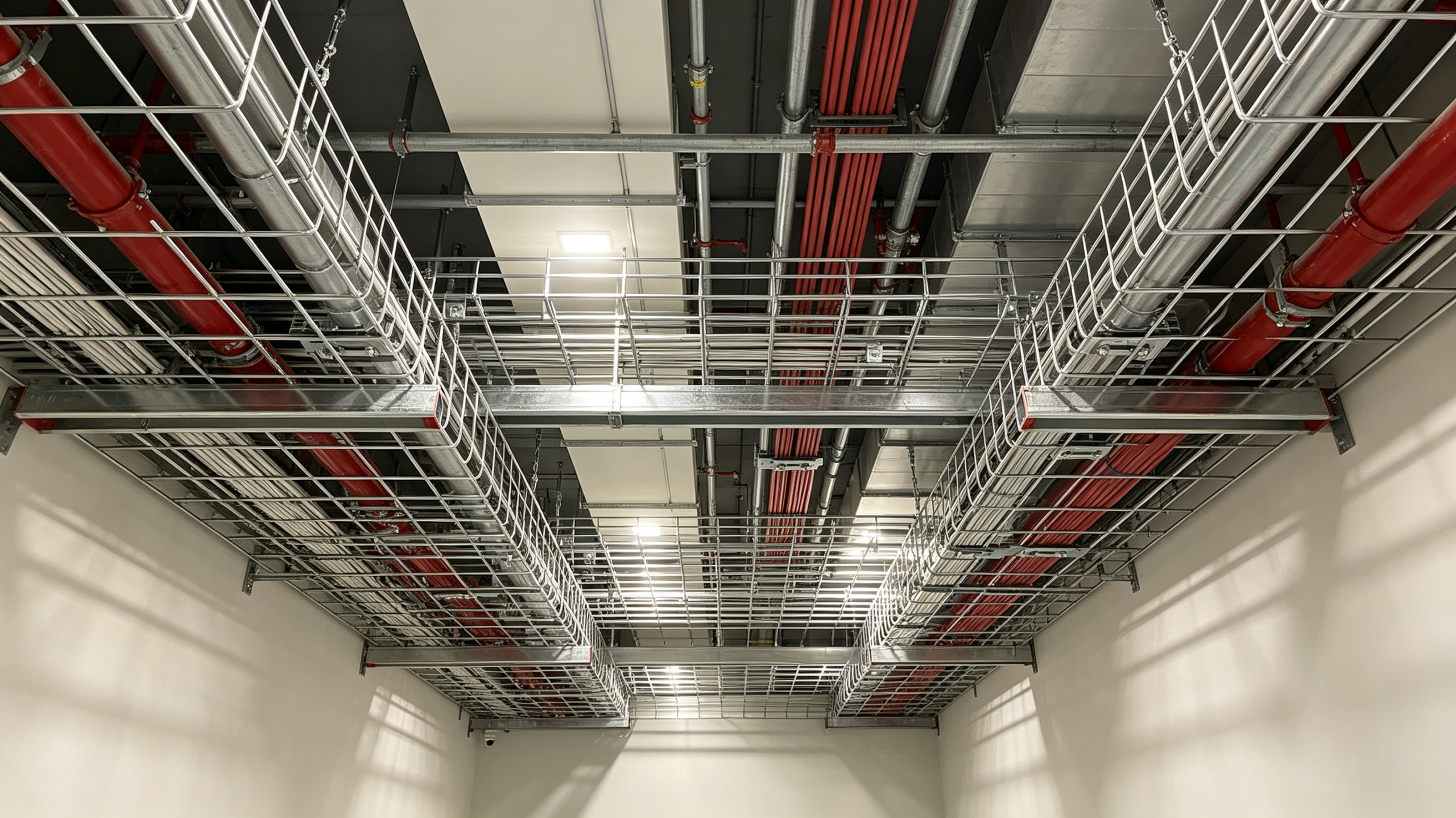
Main Application Scenarios of Wire Mesh Cable Tray
Data Centers & Server Rooms
Suitable for high-density network cable and optical fiber laying, ensuring stable heat dissipation and convenient circuit iteration.
Smart Office & Commercial Buildings
Perfect for ceiling weak current wiring, building automation control system and security monitoring line layout.
Industrial Automation Workshops
Ideal for equipment signal lines and low-voltage control cable laying in automated production workshops.
Education & Medical Institutional Buildings
Adapt to high-standard clean wiring environments, with neat layout and convenient daily maintenance.
If you need high-flexibility, heat-dissipating and low-maintenance wire mesh cable tray solutions for data center, smart building and commercial wiring projects, contact BDCABLETRAY. We provide free on-site scheme design, customized specification matching, global factory direct supply and full-cycle professional after-sales technical support.
FAQ
1. What are the unique advantages of wire mesh cable trays compared with traditional trays?
Wire mesh cable trays feature open grid heat dissipation, ultra-light weight and flexible assembly. Different from closed channel trays and heavy ladder trays, they solve heat accumulation, heavy load and difficult wiring adjustment problems. They support free cable upgrading and convenient daily maintenance, making them more suitable for modern high-density weak current and network wiring projects.
2. Are wire mesh cable trays strong enough for daily cabling work?
Yes. BDCABLETRAY wire mesh cable trays adopt high-strength full-welded steel wire structure with uniform stress distribution. Although lightweight, they have stable load capacity, fully meeting the laying requirements of network cables, optical fibers and low-voltage control cables. The overall structure is not easy to deform and can adapt to long-term stable overhead installation.
3. What projects are wire mesh cable trays most suitable for?
Wire mesh cable trays are the best choice for scenarios requiring high heat dissipation and frequent circuit iteration, including data center server rooms, smart office buildings, commercial complexes, campus buildings, medical institutions and automated industrial workshop signal wiring. They are mainly used for weak current and high-density network cabling systems.
4. Do wire mesh trays have dust accumulation problems that affect use?
Compared with mesh gap dead corners of traditional trays, wire mesh trays have a smooth and open overall structure with no hidden dust accumulation areas. Daily cleaning is simple and convenient, and dust will not affect cable heat dissipation and signal transmission. The hot-dip galvanized surface also has good dust resistance and easy cleaning performance.
5. Can wire mesh cable trays be modified and reused later?
Absolutely. BDCABLETRAY wire mesh cable trays adopt modular assembly structure, which can be freely disassembled, spliced and adjusted. When the building function or network layout is upgraded, the disassembled trays can be reused after simple sorting, with high recycling value and low long-term comprehensive project cost.