



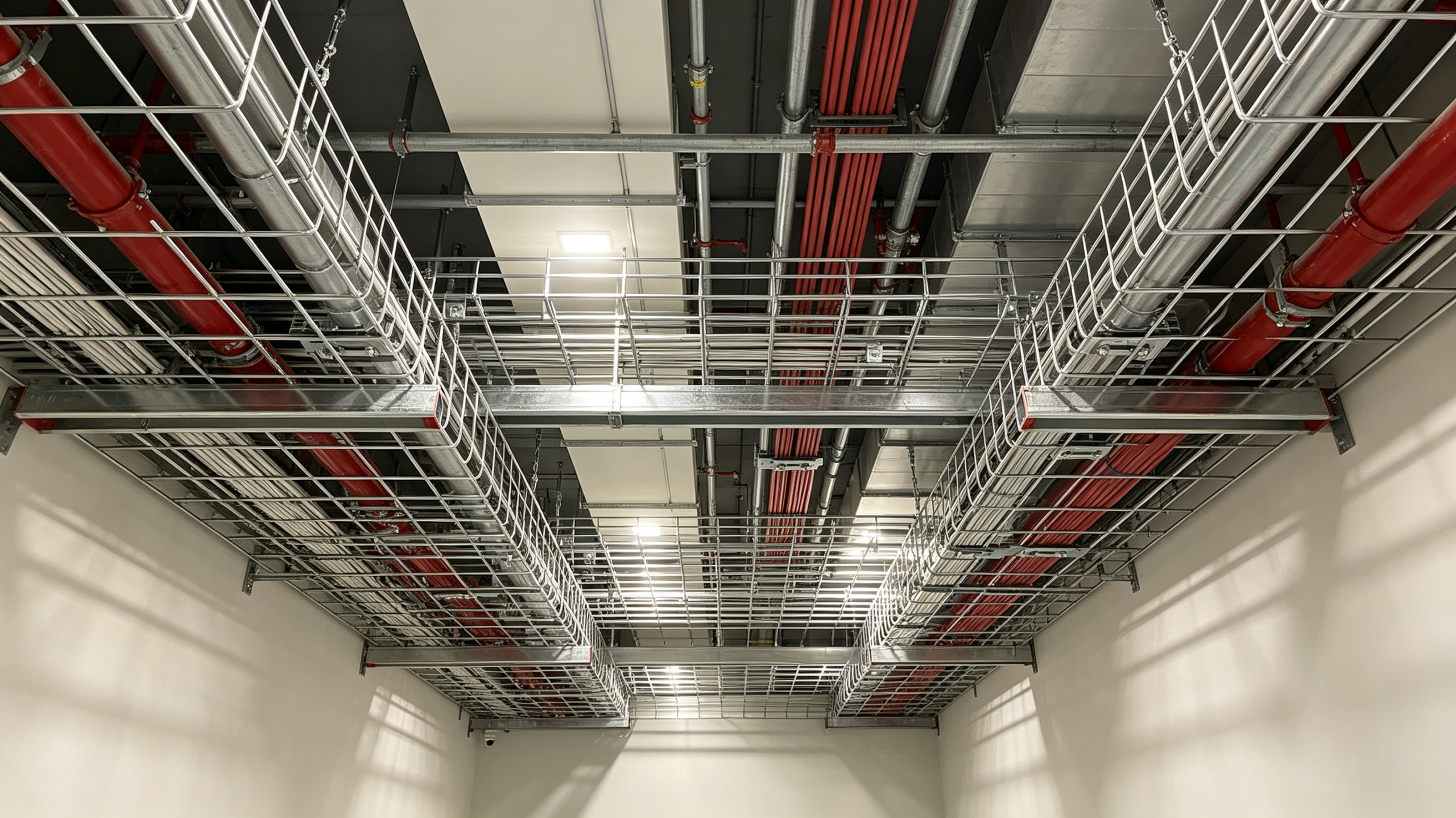
Wire mesh cable tray, also known as basket cable tray, has become a go-to choice for projects that demand flexible cable routing, easy maintenance and natural heat dissipation. Unlike rigid ladder or solid trough trays, this welded wire mesh structure can be cut and reshaped on site, which saves a great deal of time when dealing with complex ceiling routes, frequent cable upgrades or mixed power and data cabling.
Below are three completed engineering projects delivered by BDCABLETRAY, covering data center, commercial office building and pharmaceutical cleanroom. Each case shows the challenges the contractor faced, the solution we provided, and the actual results after handover.
Core Advantages of Wire Mesh Cable Tray for Modern Projects
Open mesh design improves heat dissipation
The fully open grid structure lets air flow freely around data cables, fiber and low-voltage power lines. Heat buildup is reduced, which helps maintain stable cable ampacity and lowers the risk of overheating in high-density cabling zones.
Easy modification during and after installation
Installers can cut wire mesh tray with simple tools on site, and form elbows, tees or drop-offs without waiting for prefabricated parts. This feature is especially valuable when site conditions differ from original drawings.
Clear cable visibility for maintenance
All cables inside remain visible. IT or electrical teams can quickly identify, trace, add or remove cables without removing tray covers, which cuts downtime during MAC (moves, adds, changes) work.
Engineering Case 1 — Hyperscale Data Center Expansion
Project background
A mid-sized data center expansion project needed overhead cable support for 3200 meters of mixed copper network cables, fiber optic lines and low-voltage power cables. The construction schedule was tight, and the design team expected multiple rounds of cable adjustments after the main installation finished.
Key challenges
The original specification used perforated metal tray. The contractor found prefabricated bends and fittings slowed down installation. Any later cable modification would require removing whole tray sections, which would interrupt server deployment. Heat accumulation was also a concern for dense fiber bundles.
BDCABLETRAY solution
We supplied electro-galvanized wire mesh cable trays with matching couplers, drop-out fittings and trapeze hangers. Our technical team reviewed the cable load and support spacing to avoid sagging. We also provided on-site installation guidance for the construction crew to make custom bends and tee joints.
Project result
The installation speed improved significantly. The crew finished the overhead cabling system 12 days ahead of the planned schedule. During the first year of operation, the IT team completed several cable upgrades quickly, no tray replacement required. Thermal inspection showed no abnormal heat accumulation on cable bundles.
Engineering Case 2 — Multi-Story Commercial Office Fit-out
Project background
A new office building with open-plan workspaces required cable routing above suspended ceilings for CCTV, access control, VOIP, office network and small power cables. Ceiling space was limited, with many beams, pipes and ventilation ducts crossing the cable route.
Key challenges
The routing path had many direction changes and obstacles. Rigid trays would need dozens of custom prefabricated elbows, which would increase lead time and cost. The MEP team also needed to adjust cable routes while other trades were working in the ceiling void.
BDCABLETRAY solution
BDCABLETRAY delivered lightweight wire mesh trays in multiple widths. The installers cut and bent sections on site to navigate around pipes and beams. We supplied cable dividers to separate power and data cables, reducing electromagnetic interference.
Project result
The MEP team avoided ordering dozens of custom metal fittings. Material cost for cable support was reduced, and the whole ceiling cabling work aligned with the overall construction timeline. The final inspection passed smoothly, and cable tracing for future office reconfiguration is straightforward.
Engineering Case 3 — Pharmaceutical Cleanroom
Project background
A pharmaceutical production cleanroom required cable management for control and sensor cables. The site had strict hygiene requirements, and the cable support system had to avoid dust buildup and be easy to wipe down.
Key challenges
Solid bottom trays trap dust and particles. Sharp edges from poor fabrication could damage cable jackets and create contamination risks. The project required stainless steel material to resist regular washdown cleaning.
BDCABLETRAY solution
We provided SS304 stainless steel wire mesh cable trays with smooth, deburred wire joints. The open mesh surface leaves no flat area for dust accumulation, and the surface can be wiped easily during routine cleaning. All fasteners were matched stainless steel to prevent corrosion.
Project result
The cleanroom passed hygiene validation. After two years of operation, the tray surface remains clean and free of rust. Maintenance teams can inspect cables without disassembly.
Common Pitfalls When Using Wire Mesh Cable Tray
Ignoring load limits and support spacing
Wire mesh tray is lightweight, but it has a defined maximum load rating. Too long unsupported spans will cause sagging and cable damage. Always calculate total cable weight before deciding hanger spacing.
Leaving sharp cut edges unprotected
On-site cutting creates sharp wire ends. Without edge protection, the sharp points can slice cable jackets over time, especially when cables shift or vibrate.
Overfilling the tray beyond allowable fill ratio
Even with good airflow, overloaded wire mesh trays create thermal risks. Follow local electrical codes and keep enough spare space for future cable additions.
Contact BDCABLETRAY
If you are planning a wire mesh cable tray project for data center, commercial building or cleanroom, BDCABLETRAY offers electro-galvanized, hot-dip galvanized and stainless steel wire mesh cable trays together with full accessories. Our engineers can check your cable schedule, load requirements and site environment to provide layout suggestions and quotation. Contact BDCABLETRAY for technical support and product details.
FAQ
Q1: What is the typical service life of electro-galvanized wire mesh cable tray? For indoor dry environments, electro-galvanized wire mesh tray can serve 10 to 15 years under normal conditions. It is not recommended for humid, coastal or chemical exposure sites, where hot-dip galvanized or stainless steel grades are better options.
Q2: Can wire mesh cable tray carry heavy power cables? Wire mesh tray is mainly designed for data, fiber and light low-voltage cables. For heavy high-power cable bundles, you need to check load tables and support spacing. Heavy power applications usually prefer ladder cable trays instead.
Q3: Does wire mesh cable tray need grounding? Metal wire mesh cable tray is a conductive metal system, so grounding and bonding are required following local electrical codes. Proper grounding protects against electric fault risks and supports safety compliance.
Q4: Can installers cut wire mesh cable tray on construction site? Yes, wire mesh tray can be cut with simple metal cutting tools. After cutting, you must smooth the sharp edges and add protective sleeves to prevent cable jacket abrasion.
Q5: Does BDCABLETRAY supply custom wire mesh cable tray sizes and accessories? Yes. BDCABLETRAY manufactures wire mesh trays in different widths, depths and wire gauges. We also stock couplers, hangers, dividers, drop fittings and other accessories. Send your drawings or site requirements for a custom proposal.
Do you want me to shorten the article or adjust the wording to make it sound more conversational for better Google SEO?