



In modern electrical installation projects, especially for data centers, commercial buildings, smart warehouses and light industrial workshops, traditional rigid cable trays often bring many practical limitations. Poor ventilation, difficult cable maintenance and inflexible layout adjustments frequently trouble construction teams. This is why more and more overseas engineering contractors choose wire mesh cable trays for their flexible structure, open ventilation and easy retrofitting features. As an experienced China-based cable tray manufacturer, BDCABLETRAY has completed dozens of successful wire mesh cable tray projects for global clients. We share real project cases in this article to show how our mesh tray solutions solve on-site wiring challenges.
Real Challenges Found in On-Site Wiring Projects
Heat Build-Up in Dense Cable Layouts
Many server rooms and office floors feature dense network cables and power lines. Closed or semi-closed cable trays trap heat continuously during long-hour operation. Over time, high temperature accelerates cable insulation aging, increases circuit failure risks and raises room cooling costs. Without effective ventilation, the whole wiring system becomes unstable and hard to maintain.
Troublesome Cable Inspection and Upgrades
Traditional cable trays require workers to remove covers and disassemble parts when checking lines, replacing cables or expanding circuits. This process slows down construction progress and increases labor costs. For projects that require frequent system upgrades, rigid tray structures seriously restrict later modifications.
Heavy Structure Increases Construction Burden
Standard steel trays are heavy and require dense supporting brackets. For ceiling suspension and high-altitude laying scenarios, heavy trays not only consume more installation materials but also bring extra structural load to the building. This issue is particularly obvious in renovation projects with limited load-bearing capacity.
BDCABLETRAY Wire Mesh Cable Tray Typical Project Cases
Medium-Size Data Center Wiring Renovation Project
A data center renovation project in Southeast Asia needed to upgrade its internal cable management system. The original closed trays caused obvious heat accumulation, leading to frequent high-temperature alarms in server equipment. In addition, the technical team needed flexible wiring structures to support future server expansion and line adjustment.
BDCABLETRAY provided customized hot-dip galvanized wire mesh cable trays for this project. The fully open mesh structure delivers 360-degree natural ventilation, effectively lowering ambient temperature inside the equipment room. All network cables and power cables are clearly arranged, avoiding stacking and heat concentration. Since mesh trays allow direct access from all directions, technicians can inspect, replace and add cables without dismantling the whole system. After the renovation, the data center achieved stable heat dissipation, lower failure rate and more flexible expandability, fully meeting long-term operation requirements.
High-End Commercial Office Building Electrical Project
A new high-rise office building project required neat, lightweight and aesthetic internal wiring solutions. The construction team abandoned bulky traditional steel trays to avoid heavy ceiling load and messy hidden wiring. They prioritized products that are easy to install and convenient for future office layout adjustments.
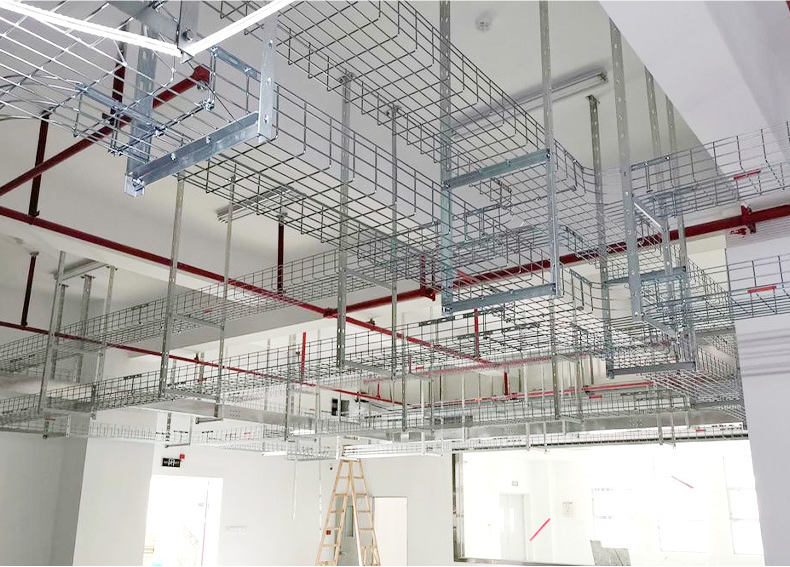
We supplied high-quality electro-galvanized wire mesh cable trays for this project. The lightweight mesh structure greatly reduced ceiling pressure and shortened construction cycle. The smooth galvanized surface prevents cable scratching and rust formation. With modular splicing design, workers can freely adjust tray routes to adapt to ceiling pipes, corners and crossing structures. After completion, the wiring system is tidy, standard and easy to manage, perfectly matching the high-standard interior electrical construction of commercial buildings.
Smart Warehouse Production Line Renovation Project
An intelligent logistics warehouse updated its automated handling and sorting equipment. The original fixed cable layout could not adapt to frequent equipment position changes and functional area adjustments. The customer needed reusable, disassemblable and durable cable tray solutions.
BDCABLETRAY wire mesh cable trays were applied to the whole warehouse renovation. Thanks to the modular assembly structure, the trays can be disassembled, adjusted and reinstalled freely without material waste. The anti-corrosion galvanized layer resists indoor dust and dry air erosion, maintaining stable performance in long-term industrial use. The open structure also helps dissipate heat generated by automated equipment lines, ensuring safe and stable warehouse operation throughout the year.
Why BDCABLETRAY Wire Mesh Cable Tray Performs Better On-Site
Full Open Structure for Superior Heat Dissipation
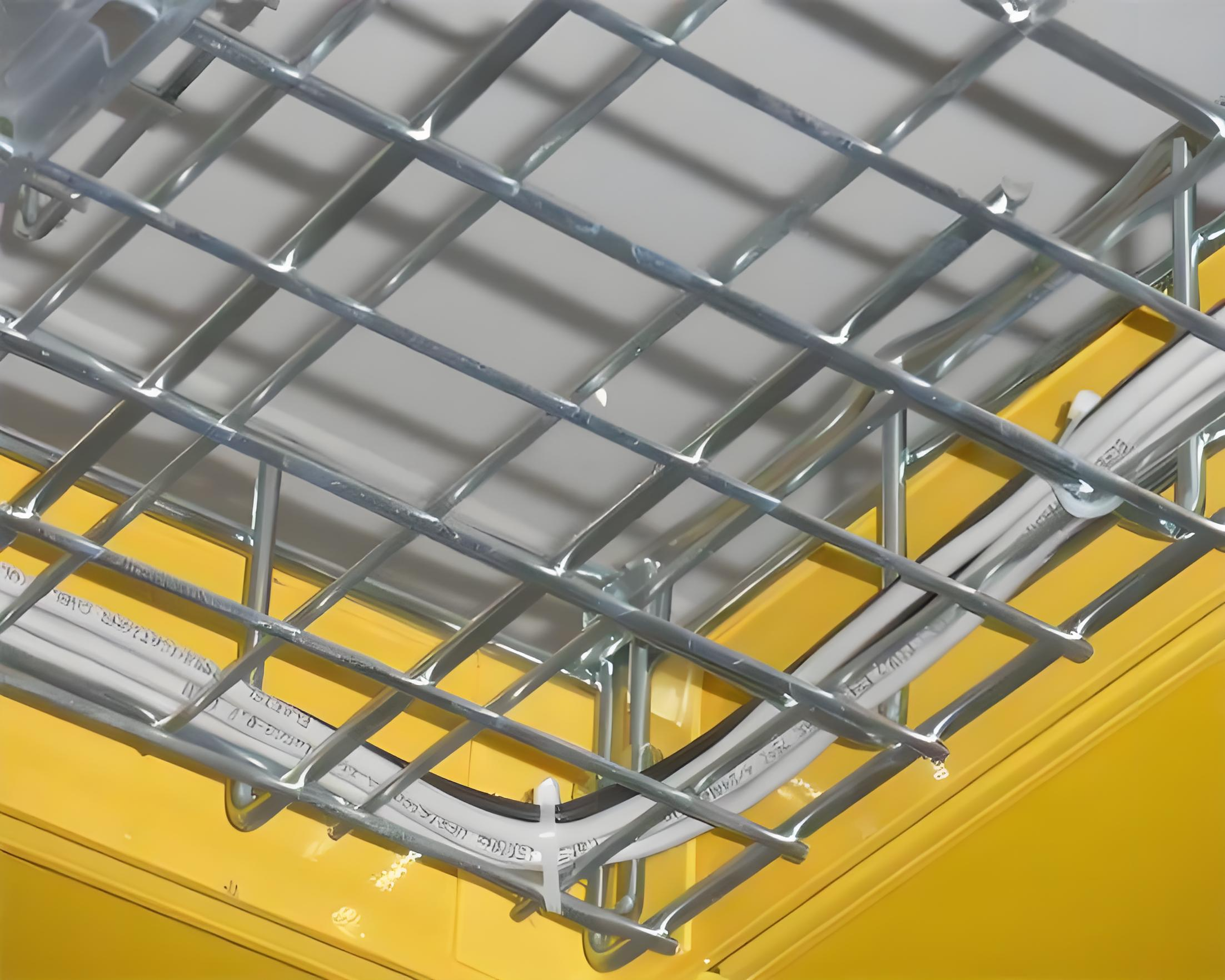
Different from closed cable management products, our wire mesh trays have no shielding barriers. Air flows freely around every cable, effectively reducing operating temperature and extending cable service life. This advantage is irreplaceable for dense wiring and 24-hour continuous operation scenarios.
Modular Design Brings High Flexibility
All mesh trays and accessories are standardized and interchangeable. No on-site welding or cutting is required. Construction teams can quickly complete laying, turning and crossing layouts according to site conditions. For later project expansion and layout adjustment, the trays can be reused many times to save project costs.
Stable Anti-Corrosion & Long Service Life
We provide electro-galvanized and hot-dip galvanized two surface treatments for different usage environments. The uniform zinc layer effectively isolates air oxidation and dust corrosion. The welded mesh structure is firm and not easy to loose or deform, ensuring stable long-term use in indoor and mild outdoor environments.
If you are looking for stable, flexible and cost-effective wire mesh cable trays for data centers, office buildings, warehouse renovations and light industrial projects, feel free to contact BDCABLETRAY. We provide free project evaluation, custom size solutions, factory direct prices and full after-sales technical support for your global engineering projects.
FAQ
1. What are the main application scenarios of wire mesh cable trays?
Wire mesh cable trays are ideal for light to medium-duty wiring projects. They are widely used in data centers, server rooms, commercial office buildings, smart warehouses, supermarket electrical systems and indoor light industrial workshops. They are especially suitable for projects requiring high heat dissipation, frequent maintenance and flexible layout adjustment.
2. What is the difference between wire mesh cable tray and traditional cable tray?
Wire mesh cable trays adopt an open mesh structure with lightweight body and all-direction cable access, delivering better heat dissipation and simpler maintenance. Traditional ladder or solid trays are heavier, with closed structures that easily accumulate heat and require complicated disassembly during cable adjustment. Mesh trays are more flexible and cost-effective for modern wiring projects.
3. Are BDCABLETRAY wire mesh cable trays rust resistant?
Yes. All our wire mesh cable trays undergo strict galvanizing treatment. Electro-galvanized trays work well in dry indoor environments, while hot-dip galvanized versions provide stronger anti-rust and anti-corrosion performance for humid and outdoor environments. Both treatments effectively avoid oxidation and rust during long-term use.
4. Can you customize wire mesh cable trays for special project layouts?
Absolutely. BDCABLETRAY supports full-range customization. We can adjust tray width, height, wire diameter and mesh spacing according to project requirements. We also provide custom elbows, tees and special connectors to adapt to complex on-site wiring routes, meeting personalized engineering needs.
5. Is wire mesh cable tray easy and fast to install?
Yes. Our wire mesh cable trays adopt fully modular assembly design. All parts match perfectly with standard accessories. No welding, painting or secondary processing is needed on site. The installation process is simple and efficient, greatly saving construction time and labor costs compared with traditional cable trays.