



Project Overview
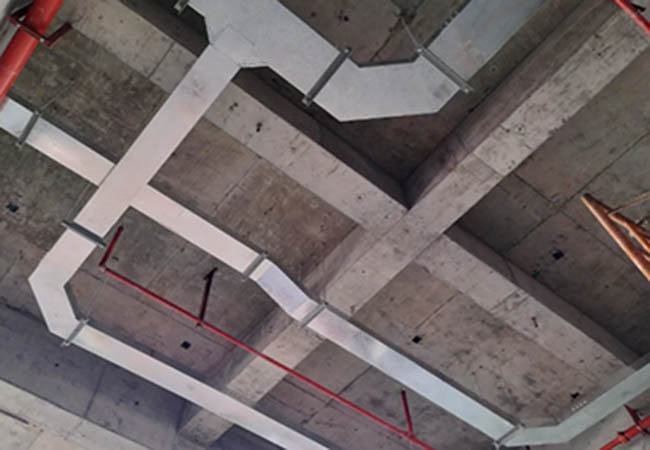
This project is a petrochemical plant expansion control room located in Southeast Asia. The site handles continuous process monitoring, analog signal cables and fiber optic communication lines. The main concern was signal interference, dust accumulation and occasional chemical splashes from adjacent processing zones. The engineering team ruled out ladder tray and wire mesh tray, and turned to solid bottom cable trays from BDCABLETRAY for full containment and EMI shielding.
Key Site Challenges
Chemical splashes and fine dust could easily land on exposed control cables. Unshielded open-style trays would pick up electromagnetic noise from nearby motor drives, causing unstable sensor feedback. Small instrument cables also tended to sag and slip through openings on ventilated trays. The project required a tray system compliant with IEC 61537, with consistent galvanized coating quality and matched accessories including covers, couplings and drop-outs.
BDCABLETRAY Solution & Product Specs
Material and surface finish: Hot-dip galvanized steel solid bottom cable tray. Zinc coating thickness reaches 86μm, suitable for indoor industrial atmosphere with light chemical exposure. Size selection: 300mm width, 100mm depth, standard 3m sections. Matching solid covers were supplied for the main routing runs. Support layout: Support span set at 1.2m to keep deflection below 6mm under full cable load. All joints use insulated coupling plates for continuous grounding. Scope of supply: Total 1260 meters of solid bottom trough tray, plus elbows, tees, reducers, hold-down clamps and grounding kits. BDCABLETRAY also provided on-site layout advice before installation.
Installation Notes from Site Engineers
Drain holes were drilled at low points on long horizontal runs to avoid standing moisture inside the tray. The team separated low-voltage instrument cables and power cables into different solid bottom tray runs, rather than laying them side by side in one trough. Grounding continuity was checked section by section after mounting the covers. The install crew found the pre-punched side holes of BDCABLETRAY trays convenient for bracket fixing, which saved cutting and fitting time.
Project Outcome & Feedback
After handover and 12 months of operation, no signal drop or interference fault was reported on the instrument circuits. Dust and chemical droplets stayed outside the enclosed tray path. Cable jackets showed no abrasion or sagging issues. The contractor commented that the solid bottom tray system delivered much better protection than ventilated alternatives for this control room environment. They also arranged a repeat order for a second phase auxiliary building.
If you need solid bottom cable tray for control rooms, chemical plants, data rooms or water treatment facilities, contact BDCABLETRAY for custom drawings, load calculation and quotation.
FAQ
What is the main difference between solid bottom cable tray and perforated tray?
Solid bottom cable tray has a fully closed base without ventilation holes. It offers better EMI shielding and protection against dust, liquid splashes and debris. Perforated tray allows air flow and suits power cables that need heat dissipation. Solid trough trays are usually the pick for sensitive control and signal wiring.
Can solid bottom cable tray be used outdoors?
It can be used outdoors, but extra anti-corrosion treatment such as powder coating or SS316 stainless steel is recommended. Drain holes must be arranged properly to collect rainwater, because standing water inside the tray will speed up corrosion.
Does solid bottom cable tray need a cover?
Covers are optional, but highly recommended for control rooms, chemical workshops and areas with falling debris. Covers boost shielding performance and stop contaminants from settling on cable insulation.
Which standard does BDCABLETRAY solid bottom cable tray follow?
Our solid bottom cable trays are manufactured to meet IEC 61537, and we can also produce to NEMA VE1 requirements for North America projects. Load test reports and material certificates are available upon request.
Is solid bottom cable tray suitable for high-current power cables?
It is not the first choice for dense high-power cable routes. The closed structure limits heat dissipation. For large power cables, ladder tray or perforated tray is more appropriate. Solid bottom trays work best for instrument, fiber, data and low-power control cables.