



Cable Tray Load Capacity: How to Calculate and Select the Right System
Choosing a cable tray with the correct load capacity is essential for industrial electrical installations. An undersized cable tray may experience excessive deflection or structural damage, while an oversized system can increase project costs.
For electrical contractors, engineering companies and project purchasers, understanding cable tray load capacity helps ensure reliable cable support and efficient project planning.
This guide explains how to calculate cable loads and select a suitable cable tray system for industrial applications.

1. What Is Cable Tray Load Capacity?
Cable tray load capacity refers to the maximum load a cable tray can safely support under specified installation and loading conditions.
It is commonly expressed as a uniformly distributed load (UDL), measured in kg/m or lb/ft, at a specified support span.
The actual capacity depends on:
- Tray width and side height.
- Wire diameter or material thickness.
- Tray structure and material strength.
- Support spacing.
- Connection and installation methods.
- Applicable additional loads.
A cable tray’s load rating must always be evaluated together with its support span.
2. How to Calculate Cable Tray Load
The first step is to calculate the combined weight of all cables installed in the tray.
Basic Formula:
Cable Load per Meter = Sum of Individual Cable Weights per Meter
For example, an industrial installation contains:
| Cable Type | Quantity | Weight per Cable |
|---|---|---|
| Power Cable | 5 | 2 kg/m |
| Control Cable | 8 | 1 kg/m |
| Communication Cable | 4 | 0.5 kg/m |
Total cable load:
(5 × 2) + (8 × 1) + (4 × 0.5) = 18 kg/m
This is the calculated cable load only.
For final selection, also consider the cable tray’s own weight, future cable additions where required, and other applicable project loads such as external environmental loads.
3. How Does Support Span Affect Load Capacity?
Support span is the distance between two adjacent cable tray supports.
It directly affects the structural performance and deflection of the tray.
Generally:
- Shorter support spans reduce the structural demand on each tray section.
- Longer support spans require greater structural capacity.
- Higher cable loads require suitable tray reinforcement and support arrangements.
For example, a cable tray rated for a 1.5 m support span should not automatically be assumed suitable for a 3 m span.
Always check the manufacturer’s load-span table for the exact tray configuration and installation conditions.
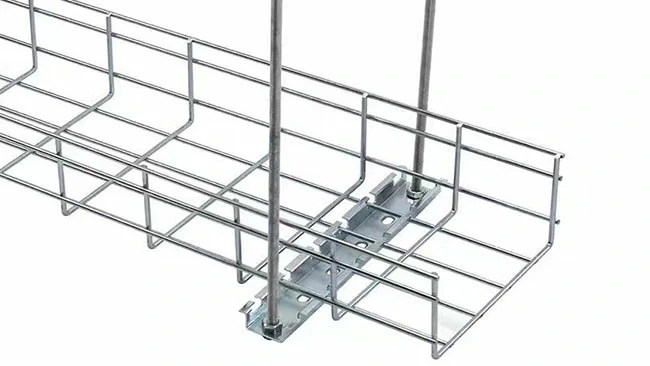
4. How to Select the Right Cable Tray Load Rating
Before purchasing, evaluate these five factors:
1. Cable Load: Calculate the total weight of installed cables per meter.
2. Tray Dimensions: Confirm the required width and side height according to cable quantities.
3. Wire Diameter: For wire mesh cable trays, select suitable wire diameters according to structural requirements.
4. Support Span: Confirm the distance between supports and the manufacturer’s rated capacity at that span.
5. Future Expansion: Allow additional capacity where required by the project design.
The selected tray’s rated safe working load must meet or exceed the project’s design load under the specified support conditions.
5. What Should Buyers Check Before Ordering?
For industrial cable tray projects, request the following information from your manufacturer:
- Product dimensions and wire diameter.
- Mesh opening specifications.
- Material and surface treatment.
- Rated load capacity.
- Recommended support span.
- Load-span test reports, where applicable.
- Compatible connectors and mounting accessories.
Relevant technical references include IEC 61537 and NEMA VE 1. Always confirm the applicable standard and edition required by your project.
6. Customized Wire Mesh Cable Tray Solutions from BDCABLETRAY
BDCABLETRAY provides wire mesh cable tray solutions for industrial manufacturing, commercial buildings, data centers and infrastructure projects.
Our products can be customized according to project requirements, including:
- Wire diameter and mesh opening.
- Tray width and side height.
- Section length.
- Material and surface treatment.
- Connectors and mounting accessories.
For projects with specific loading requirements, provide your cable weight, support span and technical drawings so the suitable product configuration can be evaluated.
Need a wire mesh cable tray for your project?
Send us your technical drawings, cable load requirements or bill of quantities (BOQ). Our team can help review your specifications and provide a suitable product solution and quotation.
Contact BDCABLETRAY today to discuss your project.