



Heavy industrial facilities, including manufacturing plants, power workshops and chemical factories, have always faced tough cable management challenges. Unlike ordinary office weak-current wiring, industrial sites involve large-diameter power cables, dense equipment wiring and long-distance overhead laying. Traditional solid-bottom cable trays often cause poor heat dissipation, excessive internal temperature and accelerated cable aging. Meanwhile, low-load wire mesh trays cannot bear the weight of heavy power lines, leading to sagging deformation and potential safety hazards.
Ladder cable trays are specially designed for heavy-load industrial cabling scenarios. Featuring open ventilation structure, super strong load-bearing capacity and high adaptability for long-span installation, they have become the preferred solution for industrial power distribution projects. BDCABLETRAY recently completed a full-scale ladder cable tray upgrading project for a heavy machinery manufacturing plant. This real case shares on-site pain points, customized ladder tray solutions and long-term operational benefits for industrial heavy-duty wiring systems.
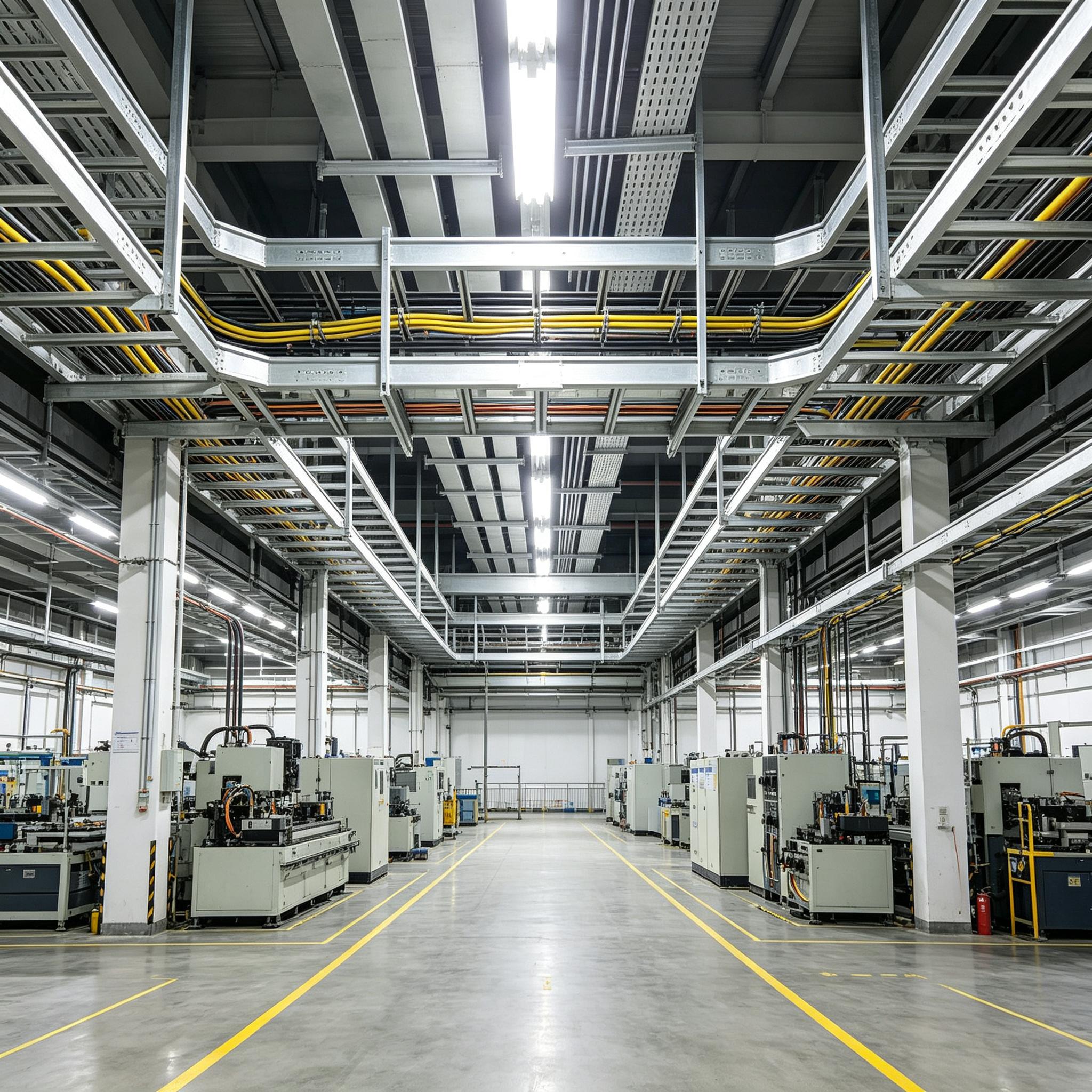
Project Background & Original Cabling System Defects
The client is a large heavy machinery manufacturing enterprise, covering a 4500-square-meter production and power distribution workshop. The workshop is equipped with a large number of heavy-duty mechanical equipment, high-power motors and automated production lines, requiring massive high-voltage power cables and control signal lines. The original cabling system adopted mixed ordinary trays, which exposed many defects after years of operation and could no longer meet safe and stable production standards.
Poor heat dissipation causes frequent cable overheating
The original closed solid trays were used for heavy power cable laying. The fully enclosed structure cannot form effective air circulation. A large amount of heat generated by high-power cables during long-term operation accumulates inside the trays, resulting in excessive cable temperature. Long-term overheating leads to aging insulation skin, increased line loss and even occasional tripping faults, seriously affecting continuous production.
Insufficient load-bearing capacity leads to tray deformation
Partial lightweight trays used in the early stage have limited bearing strength. After laying dense large-diameter power cables, the trays suffer from serious sagging and local deformation. Long-term stress accumulation causes loose fixing parts, bringing hidden dangers of cable falling and line short circuit.
Difficult daily maintenance and line inspection
Closed tray structure completely covers the cables. When line aging, failure or signal abnormality occurs, maintenance personnel need to disassemble a large number of tray cover plates for troubleshooting. The maintenance process is time-consuming and labor-intensive, resulting in long equipment downtime and huge economic losses.
Poor environmental adaptability for industrial workshops
The workshop environment has industrial dust, slight oil pollution and long-term equipment vibration. Ordinary low-quality trays are prone to rust, paint peeling and structural loosening after vibration and corrosion, failing to adapt to long-term high-intensity industrial operation scenarios.
BDCABLETRAY Custom Ladder Cable Tray Solution
Combined with the client’s core demands of heavy-load bearing, high-efficiency heat dissipation, convenient maintenance and long-term stability, BDCABLETRAY completely replaced the original mixed tray system with customized heavy-duty ladder cable trays. We formulated targeted laying schemes for long-span overhead wiring, equipment intensive areas and power distribution main lines to build a safe, stable and easy-maintenance industrial cabling system.
Open ladder structure for full air convection heat dissipation
BDCABLETRAY ladder cable tray adopts hollow ladder side rail and cross rung design, with no closed shielding structure on the bottom and sides. The fully open structure realizes 360° air convection for internal cables, quickly dissipating heat generated by high-power cables during operation. It thoroughly solves the overheating aging problem of closed trays and effectively extends the service life of power lines.
Reinforced heavy-duty structure for super load-bearing performance
Different from ordinary lightweight ladder trays, this project adopts thickened side rails and widened reinforced rungs. The overall structural rigidity is greatly improved, with uniform stress distribution. It can stably bear the weight of dense large-diameter power cables, adapting to long-span overhead laying. After long-term operation, no sagging or deformation occurs, fully meeting industrial heavy-load wiring standards.
Optimized rung spacing for classified cable laying
According to the client’s mixed laying demands of power cables and control lines, we customized scientific rung spacing. The structure avoids mutual extrusion and friction between cables, realizes classified placement of different lines, reduces signal interference, and ensures stable transmission of power and control signals.
High-standard anti-corrosion surface treatment
All ladder trays adopt hot-dip galvanized or electrostatic spraying surface technology. The dense protective layer resists workshop dust, oil pollution, humidity and long-term mechanical vibration corrosion. It avoids rust, peeling and structural damage, maintaining stable structural performance and neat appearance in harsh industrial environments for a long time.
Modular splicing design for flexible laying
The ladder tray adopts standardized modular assembly structure, matched with professional elbows, tees, reducing joints and connecting accessories. It can flexibly adapt to complex workshop wiring routes, cross-beam laying and long-distance linear wiring, with simple installation and high construction efficiency.
Project Operation Effects & Practical Improvements
After the installation and commissioning of BDCABLETRAY ladder cable trays, the workshop’s industrial cabling system achieved comprehensive upgrading. After 12 months of stable operation, all trays are free of deformation, rust and loosening, and the overall operation state of the line system is significantly optimized.
In terms of safety performance, the open heat dissipation structure completely solves the cable overheating problem. The cable operating temperature is effectively controlled, the insulation aging rate is greatly reduced, and line failure and equipment tripping accidents are basically eliminated. The reinforced heavy-duty structure ensures stable bearing of heavy cables, avoiding safety hazards such as tray sagging and cable falling.
In terms of later maintenance, the exposed ladder structure makes all cables clearly visible. Maintenance personnel can quickly inspect line status and locate faults without disassembling the tray structure, greatly improving maintenance efficiency and reducing equipment downtime losses. The durable anti-corrosion process also realizes zero daily maintenance of the tray system, saving long-term operation costs.
Main Application Scenarios of BDCABLETRAY Ladder Cable Tray
Industrial Manufacturing Plant Power Wiring
Suitable for heavy machinery workshops, automobile factories and processing plants with high-power equipment and dense power cables, meeting heavy-load and long-span laying demands.
Power Distribution & Substation Projects
Ideal for power plants, substations and distribution rooms, adapting to large-diameter power cable laying and long-term continuous high-load operation.
Chemical & Harsh Environment Workshops
Perfect for chemical plants, metallurgical workshops and coastal industrial sites with dust, humidity and slight corrosive substances, with strong environmental adaptability.
Long-Span Overhead Cabling Projects
Applicable for factory overhead long-distance wiring, corridor cable laying and large-space industrial wiring scenarios, with stable bearing and strong spanning capacity.
Core Advantages of BDCABLETRAY Ladder Cable Tray
Superior Heat Dissipation Prevents Cable Aging
Full open ladder structure realizes omnidirectional air convection, efficiently dissipating cable operating heat. It solves the core pain point of easy overheating and aging of industrial heavy-load cables, ensuring long-term stable line operation.
Heavy-Duty Structure & Strong Span Adaptability
Reinforced thickened structure has ultra-high load-bearing capacity, which can adapt to long-span overhead laying of heavy power cables without deformation or sagging, meeting strict industrial safety standards.
Visible Structure Simplifies Daily Maintenance
The open design requires no disassembly and assembly for line inspection and fault troubleshooting, greatly reducing maintenance difficulty and downtime loss, improving overall operational efficiency.
Durable Anti-Corrosion & Low Long-Term Cost
Professional anti-corrosion surface treatment adapts to various harsh industrial environments, with long service life and zero daily maintenance. It reduces repeated replacement and maintenance costs for enterprises.
If you need heavy-load, heat-dissipating and durable cabling solutions for industrial plants, power distribution projects and harsh environment wiring, contact BDCABLETRAY. Our professional engineering team provides free on-site survey, customized ladder cable tray scheme design and one-stop installation guidance to create a safe and stable industrial cable management system for your project.
FAQ
1. What is the main difference between ladder cable tray and solid cable tray?
Ladder cable trays adopt open hollow structure with excellent heat dissipation and super load-bearing capacity, mainly used for heavy-duty power cable laying in industrial scenarios. Solid trays are fully enclosed with better dust and splash prevention but poor heat dissipation, suitable for light-load weak-current wiring. For high-power industrial cables, ladder trays are more safe and practical.
2. Are ladder cable trays suitable for outdoor and corrosive environments?
Yes. BDCABLETRAY ladder cable trays support multiple surface treatments including hot-dip galvanizing and electrostatic spraying. The upgraded anti-corrosion process can adapt to outdoor open-air environments, coastal salt spray and chemical workshop corrosive scenes, maintaining long-term stable structural performance without rust and deformation.
3. Can ladder trays bear long-span heavy cable laying?
Absolutely. BDCABLETRAY industrial-grade ladder trays adopt reinforced side rails and thickened rungs, with optimized stress structure. It can stably support long-span laying of large-diameter power cables, effectively avoiding sagging and deformation problems of ordinary lightweight trays, fully meeting industrial heavy-load wiring requirements.
4. Is ladder cable tray maintenance difficult in later stage?
It is far easier to maintain than closed trays. The open ladder structure exposes all cables directly. Staff can complete daily inspection, line troubleshooting and cable replacement without disassembling any tray components, greatly saving maintenance time and reducing enterprise operation and maintenance costs.
5. What scenarios are not suitable for ladder cable trays?
Ladder trays are not recommended for scenarios with serious water splashing, dense fine dust that is easy to accumulate, and high-precision signal line anti-interference requirements. For these special scenes, BDCABLETRAY recommends solid or perforated cable trays to ensure better protection effects.