



Large-scale industrial manufacturing plants, power distribution stations and heavy machinery workshops feature dense high-current power cables, long-span laying routes and 24-hour continuous load operation. In these core power scenarios, ordinary perforated or solid bottom cable trays often expose obvious defects: poor heat dissipation leads to cable ampacity attenuation, insufficient bearing capacity causes tray sagging, and closed structure easily accumulates heat to trigger insulation aging.
As the most reliable carrier for heavy-load power cable laying, ladder cable trays are widely recognized in industrial engineering for their open hollow structure, super strong bearing capacity and excellent ventilation performance. BDCABLETRAY recently completed a full power distribution wiring upgrade project for a large heavy equipment manufacturing plant, solving long-term overheating and load-bearing hidden dangers through customized heavy-duty ladder cable tray systems. This article shares real project pain points, targeted construction schemes and long-term operational benefits.
Project Background & On-Site Wiring Challenges
This project covers a 15,000 square meter heavy industrial manufacturing workshop, mainly engaged in large mechanical equipment processing and assembly. The workshop is equipped with dozens of high-power mechanical equipment, supporting 24-hour uninterrupted production. The original power distribution system adopted ordinary medium-duty cable trays. After three years of high-load operation, multiple wiring problems emerged, seriously affecting production stability and safety audit compliance.
Severe Cable Heat Accumulation & Ampacity Reduction
The workshop’s main power corridor gathers a large number of high-current power cables. The original closed tray structure led to poor air circulation and serious heat accumulation. Long-term high-temperature operation reduced cable actual current-carrying capacity, resulting in insufficient power supply, equipment startup failure and frequent overload tripping during peak production periods.
Insufficient Bearing Capacity Causing Tray Sagging
The original ordinary trays could not bear the long-term heavy load of dense power cables. Obvious bending and sagging appeared in the middle of long-span laying sections. Squeezed cables suffered insulation wear, bringing potential short-circuit and electric leakage risks, and failing to meet industrial safety operation standards.
Difficult Daily Inspection & Maintenance
Partially closed structure blocked cable observation points. The on-site engineering team could not intuitively check cable aging, loose joints and local overheating problems. Minor hidden dangers were difficult to detect in time, which easily evolved into large-scale power system failures and production shutdown losses.
Unable to Adapt to Equipment Expansion & Upgrading
With the continuous expansion of workshop production scale, new high-power equipment was added year by year. The original tray load and heat dissipation margin were seriously insufficient, unable to meet the increasing cable laying demand, requiring overall wiring renovation and upgrading.
BDCABLETRAY Custom Heavy-Duty Ladder Cable Tray Solution
Combined with the client’s heavy-load power distribution, long-span laying and high heat dissipation requirements, BDCABLETRAY abandoned the original ordinary tray system. We adopted NEMA-standard heavy-duty ladder cable trays with thickened side rails and optimized ladder spacing, matched with professional supporting and fixing accessories. The customized solution completely solved on-site heat dissipation, load-bearing and maintenance pain points, realizing safe and stable long-term operation of the power distribution system.
Open Ladder Structure Maximizes Heat Dissipation
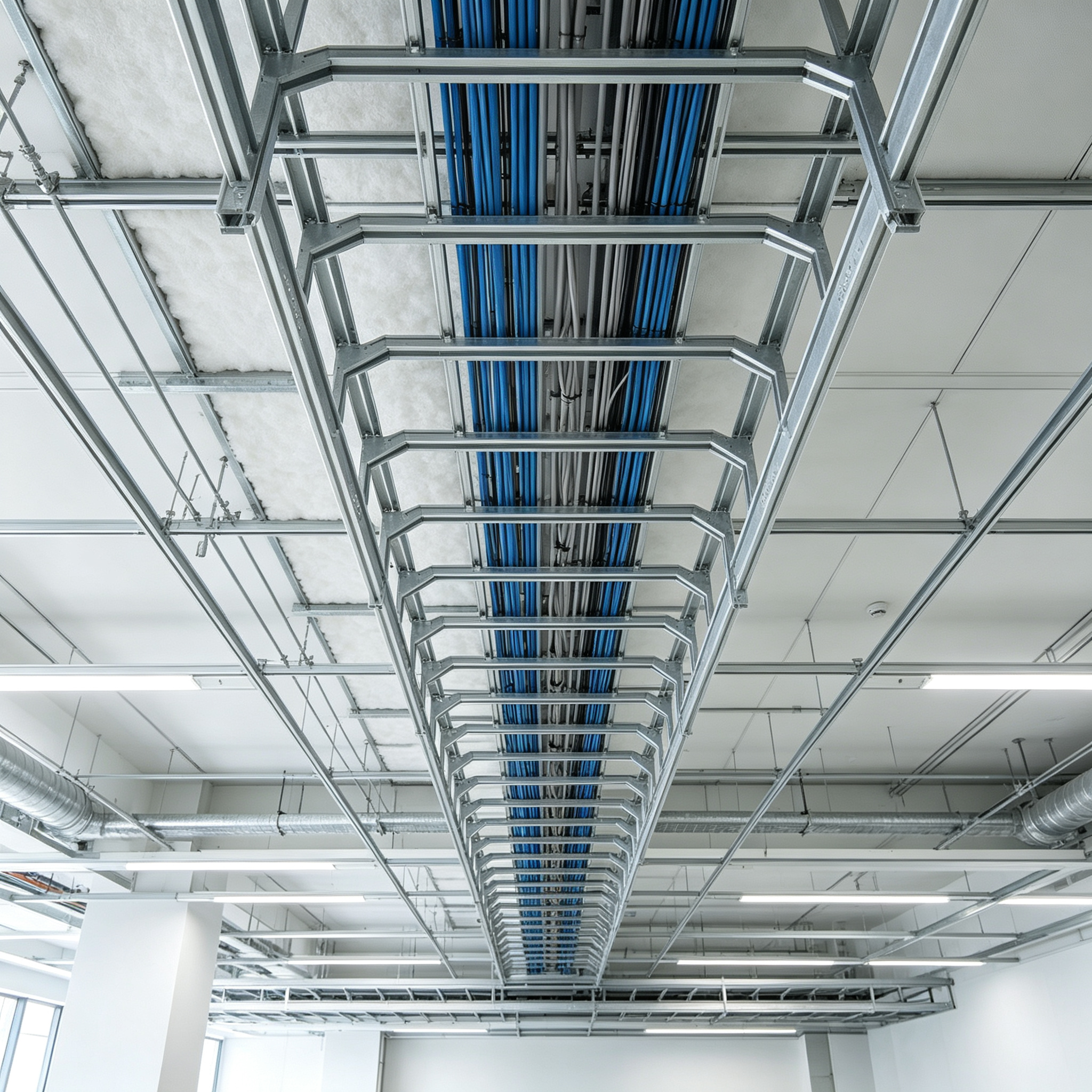
Different from closed trays, BDCABLETRAY ladder cable trays adopt fully open hollow ladder design. The unique gap structure forms uninterrupted air convection channels around the cables, quickly taking away heat generated by high-current operation. This design effectively avoids heat accumulation and ampacity derating, restoring the full current-carrying capacity of power cables and ensuring stable power supply during peak load periods.
Thickened Reinforced Structure Improves Load-Bearing Performance
All ladder trays used in the project adopt thickened steel plate integral molding and reinforced side rail technology. The overall structural rigidity is greatly improved, with super strong long-span load-bearing capacity. It can stably support dense heavy power cables without bending or sagging, even in 10-meter long-distance unsupported laying sections, fully adapting to heavy industrial high-load operation scenarios.
Optimized Ladder Spacing for Stable Cable Support
We adjusted the internal ladder spacing according to the on-site cable diameter and laying density. The reasonable spacing not only ensures no cable slipping or deformation, but also retains the maximum ventilation area. It balances stable support and efficient heat dissipation, avoiding the defects of too large spacing causing cable deformation and too dense spacing affecting heat dissipation.
Hot-Dip Galvanized Anti-Corrosion Treatment
The workshop has certain industrial dust and slight humid environment. All BDCABLETRAY ladder trays adopt hot-dip galvanized surface treatment, with uniform and dense zinc layer. It effectively resists oxidation, dust corrosion and minor mechanical friction, avoiding rust and aging, and extending the overall service life of the tray system.
Layered Laying Standardizes Power Distribution Wiring
For the workshop’s mixed layout of main power cables and branch control cables, we adopted layered ladder tray installation. High-current main cables are laid on the upper layer, and low-power branch cables on the lower layer. Classified laying avoids cable entanglement and electromagnetic interference, making the wiring layout neat and standardized, and convenient for daily inspection and fault troubleshooting.
Post-Project Operation Effects & Practical Advantages
After the completion of the ladder cable tray renovation, the workshop’s power distribution system achieved comprehensive performance upgrading. After 18 months of stable operation, the problems of equipment overload tripping, cable overheating and tray sagging were completely eliminated. The open structure ensures real-time heat dissipation of cables, and the power supply stability during peak production periods is significantly improved.
The intuitive open laying mode allows maintenance personnel to quickly observe cable surface status, joint temperature and aging problems, realizing timely troubleshooting and greatly reducing the failure rate of power systems. The super load-bearing structure completely solves the hidden danger of tray deformation, and the galvanized anti-corrosion process ensures no rust or damage in long-term industrial operation.
In addition, the reserved laying margin and stable structural performance fully meet the later equipment expansion and circuit upgrading needs, avoiding repeated wiring renovation and saving long-term engineering investment and maintenance costs for the enterprise.

Core Application Scenarios of BDCABLETRAY Ladder Cable Tray
Industrial Heavy-Load Power Distribution Corridors
Suitable for manufacturing workshops, machinery factories and industrial parks with dense high-current power cables and long-span laying requirements.
Power Plants & Substation Wiring
Ideal for main power transmission lines and high-load distribution circuits in power stations, substations and energy facilities, adapting to 24-hour continuous operation.
Large Commercial Building Main Electrical Rooms
Applicable for high-load main power supply wiring of super high-rise buildings, shopping malls and comprehensive buildings, ensuring safe and stable power distribution.
Outdoor Long-Distance Cable Laying
Adaptable for outdoor open-air power corridors and factory overhead wiring, with excellent anti-corrosion and wind-resistant stability.
Product Core Competitive Advantages
Superior Heat Dissipation & No Ampacity Derating
Open ladder hollow structure realizes 360° air circulation, thoroughly solves cable heat accumulation problem, ensures full play of cable current-carrying capacity, and avoids power supply instability caused by overheating.
Heavy-Duty Bearing & Long-Span Stability
Reinforced thickened structure meets NEMA heavy-duty standards, resisting long-term heavy load without sagging or deformation, suitable for various large-span industrial wiring scenarios.
Anti-Corrosion & Long Service Life
Multiple surface treatment processes including hot-dip galvanizing and powder coating are optional, adapting to harsh industrial environments and reducing long-term maintenance costs.
Easy Inspection & Low Failure Rate
Open laying design makes cable status clear at a glance, convenient for daily inspection, temperature measurement and fault maintenance, effectively reducing electrical safety hidden dangers.
If you need heavy-load, high heat dissipation ladder cable tray solutions for industrial power distribution, long-span wiring and power plant projects, contact BDCABLETRAY. We provide free on-site load calculation, professional layout design and factory direct supply services to help you build a safe, stable and low-maintenance industrial power wiring system.
FAQ
1. What makes ladder cable trays better than other trays for industrial power cables?
Ladder cable trays feature open hollow structure and heavy-duty reinforced design. Compared with perforated and solid bottom trays, they deliver far better heat dissipation to prevent cable overheating and ampacity derating. Their stronger load capacity supports long-span heavy cable laying without sagging, making them the best choice for high-current industrial power distribution wiring.
2. Are ladder cable trays suitable for outdoor and humid industrial environments?
Yes. BDCABLETRAY ladder cable trays adopt hot-dip galvanizing, electrostatic powder coating and other anti-corrosion treatments. The optimized surface process resists humidity, industrial dust and outdoor wind and rain erosion, effectively preventing rust and aging. They maintain stable structural performance and service life in both indoor heavy workshops and outdoor power corridors.
3. Do ladder cable trays have dust accumulation and cable damage risks?
Reasonably installed ladder trays have negligible hidden dangers. The open structure is convenient for daily dust cleaning without dead corners. The smooth ladder supports fix cables stably to avoid extrusion and friction damage. For extremely dusty scenarios, we can match protective accessories without affecting heat dissipation, balancing safety and usability.
4. Can ladder cable trays solve cable overheating and tripping problems?
Absolutely. The core advantage of ladder trays is efficient ventilation and heat dissipation. The open gap design accelerates air convection around high-load cables, reduces cable operating temperature, avoids insulation aging and local overheating, and fundamentally solves overload tripping and power supply instability caused by heat accumulation.
5. Can BDCABLETRAY customize heavy-duty ladder cable trays for special projects?
Yes. BDCABLETRAY provides one-stop customized ladder tray solutions. We can adjust plate thickness, side rail height, ladder spacing and surface anti-corrosion process according to project load, span length and environmental conditions. We also support matching elbows, tees and supporting accessories to meet personalized industrial engineering wiring needs.