



FRP cable tray gets chosen for one reason more than any other: steel could not survive the site. Over the past years we have supplied glass fiber reinforced plastic trays to plants that tried galvanized steel first, watched it corrode, and decided not to repeat the mistake. This article looks at four of those projects and what each one taught us.
If you are new to the product: FRP cable tray is a support system made from fiberglass and resin instead of metal. It carries the same power, control and instrumentation cables as steel tray, but it does not rust, does not conduct electricity, and weighs roughly a third of a steel equivalent. Those three properties decide most projects.
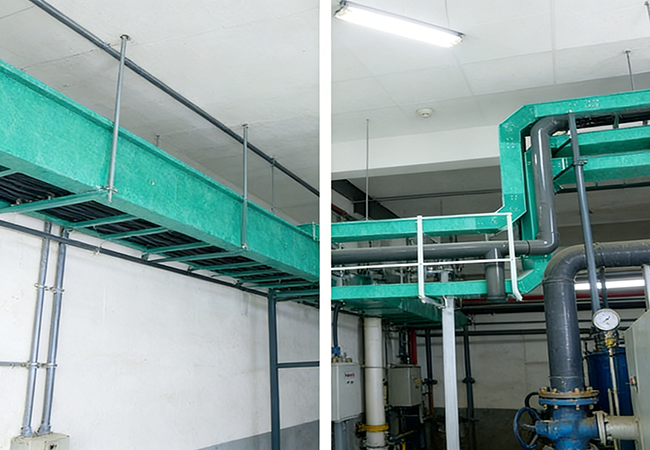
Why Plant Owners Choose FRP Cable Tray
Corrosion is the real reason
Steel trays fail from the cut ends first. Zinc coating gets damaged during cutting and drilling, moisture moves in, and rust spreads along the rung. FRP has no coating to lose. The whole section is corrosion resistant, so a scratched edge behaves exactly like a new one.
Weight changes the whole installation plan
A six-meter steel section needs a forklift or several workers. The same FRP section can be carried by two people. On overhead routes and mezzanine levels, that difference shows up in the schedule and the labor bill.
Non-conductive construction earns its place
FRP will not become a live part if a cable faults. In rooms packed with cables, that removes a whole category of risk. It also cuts bonding work compared with metal systems.
Engineering Case 1 — Battery Energy Storage Project
Project background
A utility-scale energy storage site needed to route DC cables between battery containers and inverters. The runs sat outdoors under full sun, with salt air drifting in from the nearby coast.
What went wrong with steel
The first specification called for hot-dip galvanized tray. The contractor knew from other coastal jobs that galvanizing alone would not hold up past a few seasons, so the owner asked for an alternative before installation started.
The BDCABLETRAY solution
We supplied ladder-type FRP trays with UV-stabilized resin, sized for the heavy DC cable bundles. Covers were added on the sections directly exposed to sunlight. Brackets and couplers were stainless steel to keep the fixing points as durable as the tray.
Project result
The site has completed two full years of operation without corrosion repairs. The owner has since standardized FRP on the next phase.
Engineering Case 2 — Pulp and Paper Mill
Project background
A paper mill runs wet, hot and chemically aggressive. Steam, bleach fumes and washdown water hang around the machine hall all year. Cables to motors and sensors run on trays above the equipment.
What went wrong with steel
Galvanized trays in the hall showed heavy rust within eighteen months. The mill was repainting and replacing sections on a rolling basis, which is expensive when every fix means a shutdown window.
The BDCABLETRAY solution
We delivered trough-type FRP trays with solid bases to shield cables from falling water, plus drainable design to let moisture out. All fasteners were FRP or stainless. Sections were fabricated to the exact support spacing so the crew did not rework the steel hangers.
Project result
The first FRP sections have been in service for three years with no visible degradation. The mill is gradually converting the rest of the hall.
Engineering Case 3 — Coastal Desalination Plant
Project background
A desalination plant sits meters from the sea. Chlorine dosing, salt spray and humidity work together on every metal surface. Instrument and control cables run long distances between process areas.
What went wrong with steel
Stainless steel was the safe choice, but it pushed the cable support budget up sharply. Pre-galvanized tray was cheaper and failed fast. The owner wanted a middle ground that would last.
The BDCABLETRAY solution
We proposed FRP trays for the outdoor and high-humidity zones, and kept stainless only for the few sections where mechanical strength mattered most. Resin was selected for chlorine resistance, and expansion was accounted for at every joint.
Project result
The plant passed its first major inspection with zero coating or corrosion items raised. Maintenance reports from the second year still show clean tray surfaces.
Engineering Case 4 — Semiconductor Cleanroom
Project background
A semiconductor facility had to run thousands of meters of control and data cables above a cleanroom. Dust, vibration and space were all constrained. Metal trays brought corrosion worries and added bonding complexity.
What went wrong with steel
Cleanroom washdowns and chemical vapors attacked the finish on metal trays. Any flaking coating became a contamination risk in the production area.
The BDCABLETRAY solution
We supplied wire mesh style FRP trays with smooth surfaces and rounded edges, which shed dust instead of collecting it. The non-metallic body removed grounding work on the data runs, and the light weight made installation above the ceiling grid straightforward.
Project result
The cleanroom was certified on schedule. The client reports the FRP trays are easier to keep clean than the steel sections used in the older building.
What These FRP Projects Have in Common
Resin grade must match the site
Standard FRP handles humidity well. UV, chlorine, acids and solvents each need a different resin formulation. Describe the real site conditions and the supplier can match the material.
Span and load are calculated, not guessed
FRP deflects more than steel under the same load. Support spacing and tray depth must be sized from the actual cable weight. BDCABLETRAY engineers do this from your cable schedule before production.
Accessories carry half the job
The tray is only half the system. Couplers, covers, brackets and bolts decide how long the installation lasts. On corrosive sites, steel accessories will fail long before the FRP tray does.
Contact BDCABLETRAY
Planning an FRP cable tray project? BDCABLETRAY manufactures FRP, galvanized, stainless and aluminum cable trays with a full range of accessories. Send your cable layout, span lengths and site environment, and our engineers will recommend the right type, size and resin grade. Contact BDCABLETRAY for a quotation or technical support.
FAQ
Q1: What is the lifespan of FRP cable tray in outdoor use? With UV-stabilized resin, FRP tray commonly lasts twenty years or more outdoors. Non-stabilized resin fades and turns brittle under strong sun, so outdoor projects should always specify UV stabilization.
Q2: Can FRP cable tray carry heavy power cables? Yes, when depth, width and support spacing are sized for the load. FRP is less rigid than steel, so long unsupported spans may need reinforcement or closer hangers. Load tables should be checked before ordering.
Q3: Does FRP cable tray require grounding? FRP itself is non-conductive and does not need grounding like metal tray. Cables inside still follow their own earthing requirements, and some sites add a bonding conductor for continuity.
Q4: Can FRP cable tray be cut on site? Yes, with an abrasive disc or fine-tooth saw. Cut edges should be sealed with resin or tape where corrosion resistance matters, because exposed glass fibers can absorb moisture.
Q5: Does BDCABLETRAY make custom FRP cable tray sizes? Yes. Custom widths, depths, lengths and colors are available, with matching covers, couplers, brackets and supports. Send drawings or site measurements for a tailored quotation.