



Many commercial buildings, workshop renovation and municipal wiring projects face a common wiring dilemma. Open ladder trays deliver great heat dissipation but fail to block dust, moisture and external extrusion, while traditional conduits are difficult to construct and impossible to inspect later. For instrument signal cables, weak current lines and precision control circuits, exposed installation easily causes signal interference, dust accumulation and insulation damage, bringing hidden risks to long-term stable operation.
Channel cable trays perfectly fill the gap between open trays and closed pipelines. Featuring integral closed groove structure, full surrounding protection and neat enclosed wiring, this tray type is specially designed for precision signal cables, weak current systems and short-distance equipment wiring. It balances installation efficiency, cable safety and later maintenance convenience. BDCABLETRAY recently completed a full wiring upgrading project for a comprehensive commercial office and industrial supporting park. This real on-site case shares actual project pain points, customized channel cable tray solutions and practical post-operation effects.

Project Background & On-Site Wiring Pain Points
The client is a comprehensive industrial and commercial park integrating office buildings, supporting workshops and central control rooms. The project covers office weak current wiring, workshop instrument signal wiring and public area lighting wiring. The original wiring scheme adopted scattered conduits and partial open mesh trays, resulting in messy line layout, difficult fault inspection and frequent signal instability. The client needed a standardized, fully protected and easy-maintenance cable management system to replace the old disordered wiring structure.
Open Tray Wiring Causes Dust Accumulation & Cable Damage
The original open mesh trays were used for partial weak current wiring. Long-term indoor floating dust and tiny debris accumulated on the cable surface, leading to accelerated insulation aging. In workshop semi-open areas, moist air and fine industrial dust adhered to circuit surfaces, causing occasional short-circuit risks and affecting the stability of precision instrument signal transmission.
Traditional Conduit Piping Makes Maintenance & Upgrades Difficult
Most precision signal cables were buried in closed conduits in the early stage. Once circuit faults occurred or lines needed to be added and modified, workers had to dismantle a large area of pipes and walls. The whole maintenance process was time-consuming and labor-intensive, and it was impossible to quickly locate hidden circuit faults, seriously affecting daily office and workshop operation.
Mixed Wiring Leads to Signal Interference & Disorder
Power cables, network lines and instrument signal cables were laid without standardized isolation. Mixed wiring generated electromagnetic interference, resulting in unstable network signals and delayed instrument data transmission. The disorderly wiring layout also failed to meet the park’s standardized fire safety and engineering acceptance requirements.
Uneven Wiring Appearance Affects Overall Standardization
Scattered conduit layout and exposed open tray lines made the overall wiring system messy and inconsistent. As a high-standard comprehensive industrial and commercial park, the irregular wiring structure affected the overall aesthetic and standardized management level of the site, failing to pass regular safety audits smoothly.
BDCABLETRAY Custom Channel Cable Tray Solution
Combined with the client’s dual demands of cable safety protection and standardized refined management, BDCABLETRAY formulated a targeted full-channel cable tray wiring scheme. We adopted closed anti-dust channel trays for weak current and signal lines, and matched standardized segmented layout and layered wiring design to completely solve the problems of dust pollution, signal interference and difficult maintenance in the original system.
Integrated Closed Groove Structure for Full-Cable Protection
BDCABLETRAY channel cable tray adopts one-piece rolled forming closed groove structure, equipped with matching waterproof and dustproof cover plates. The fully enclosed design completely isolates internal cables from external dust, moisture and debris erosion. It effectively prevents cable insulation aging and surface damage, and avoids short-circuit faults caused by dust accumulation, providing all-round safety protection for precision signal and weak current lines.
Standardized Segmented Layout Avoids Signal Interference
According to functional differences, we divided independent wiring areas for power cables, network communication lines and instrument control cables. The closed channel structure realizes physical isolation of different lines, effectively suppressing electromagnetic crosstalk between strong and weak current circuits. This completely solves the problems of unstable network signals and inaccurate instrument data caused by mixed wiring in the past.
Semi-Open Detachable Design Simplifies Daily Maintenance
Different from fully enclosed conduits that cannot be disassembled, BDCABLETRAY channel trays adopt movable cover plate design. Workers can directly open the cover plate for line inspection, fault troubleshooting and cable upgrading without dismantling walls or pipelines. It greatly improves the efficiency of daily circuit maintenance and later line expansion, saving a lot of manual maintenance costs.
High-Quality Surface Process Adapt to Long-Term Indoor Operation
All channel trays used in the project adopt high-standard electrostatic spraying surface treatment. The smooth and flat surface resists daily dust adhesion and is easy to clean. The uniform coating has strong anti-aging and anti-rust performance, adapting to long-term stable operation of indoor offices and workshop environments, with no paint peeling or rust deformation in long-term use.
Neat Integrated Layout Improves Project Standardization
The overall specification of the channel tray is uniform, with straight lines and consistent installation spacing. The whole wiring system is neat and standardized after construction. It completely changes the previous messy wiring state, improves the overall visual grade of the park, and fully meets engineering acceptance and safety audit standards.
Post-Project Operation Effects & Practical Improvements
After the completion of the BDCABLETRAY channel cable tray renovation, the park’s internal wiring system achieved comprehensive upgrading. After 12 months of stable operation, all trays remain flat and neat without rust or deformation. The internal cables are clean and free of dust accumulation, and the circuit operation stability is significantly improved.
In terms of circuit safety, the fully enclosed protective structure completely avoids dust and moisture erosion. The cable insulation aging rate is greatly reduced, and short-circuit and signal interference faults are basically eliminated. The transmission of office network and workshop instrument data is stable and efficient, ensuring the normal operation of office work and automated production.
In terms of later management and maintenance, the detachable cover plate design realizes rapid inspection and line upgrading. The daily circuit maintenance efficiency is increased by more than 50%, and no large-scale demolition and reconstruction is required for line expansion. The standardized closed layout also helps the enterprise pass multiple fire safety and engineering standard inspections smoothly, reducing hidden safety risks and management pressure.
Main Application Scenarios of BDCABLETRAY Channel Cable Tray
Commercial Office & Building Weak Current Wiring
Suitable for office network lines, building lighting, monitoring wiring and fire protection circuits, realizing neat wiring and stable signal transmission.
Workshop Instrument & Precision Signal Wiring
Ideal for factory central control rooms, automated instrument signal lines and sensing circuits, preventing signal interference and ensuring precise data transmission.
Public Municipal & Landscape Lighting Projects
Perfect for municipal corridor wiring, public area lighting and community supporting wiring projects, with strong environmental adaptability and high safety.
Dust & Humid Indoor Industrial Sites
Applicable for semi-open workshops, processing workshops and humid indoor environments, effectively isolating dust and moisture to protect circuit safety.
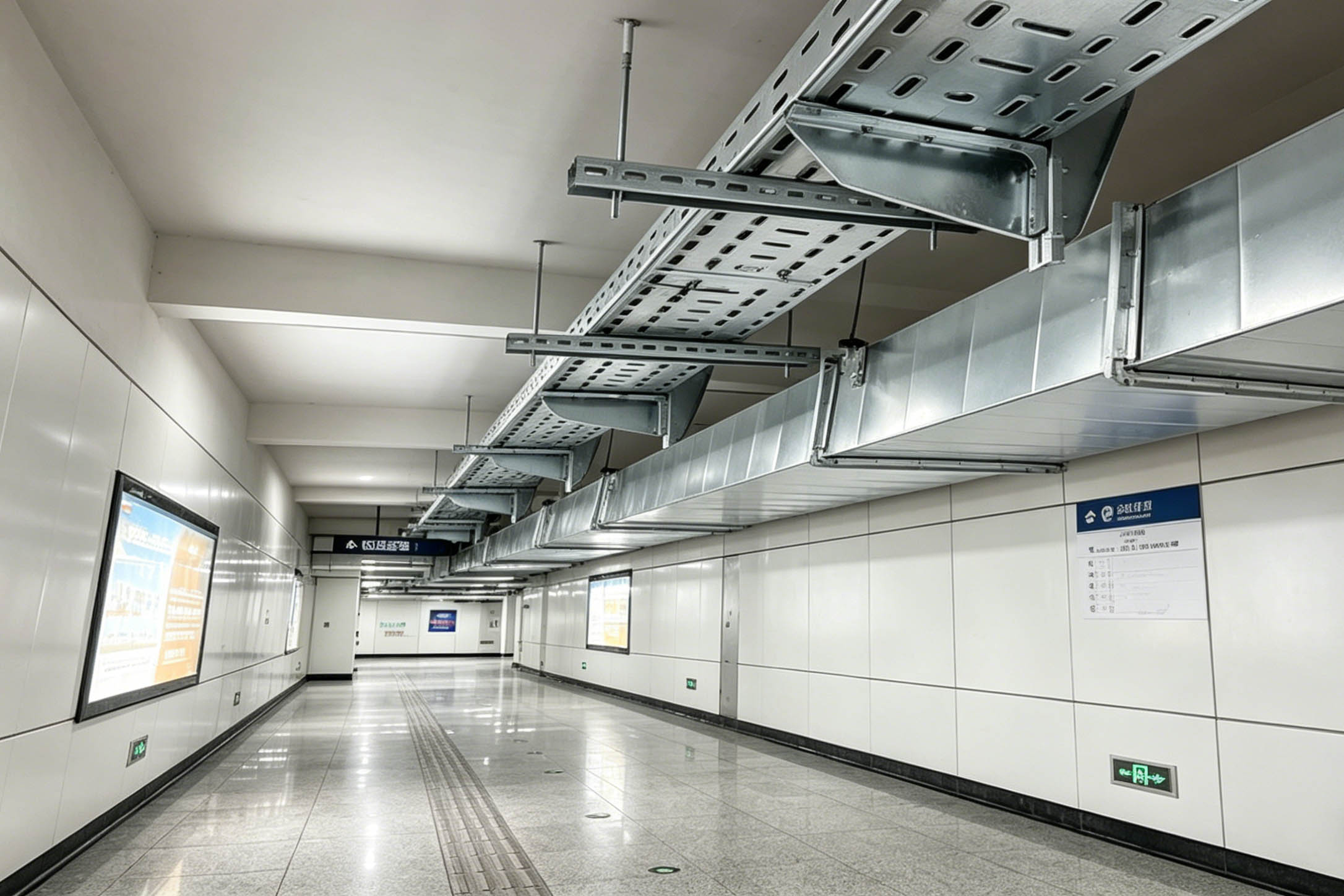
Core Product Advantages of BDCABLETRAY Channel Cable Tray
Full Enclosed Protection Prevents Dust & Moisture
Integrated closed groove + detachable cover plate structure achieves full-range protection. It effectively isolates external dust, moisture and tiny debris, avoids cable insulation damage and short-circuit faults, and extends the overall service life of wiring systems.
Effectively Isolates Signal & Avoids Interference
The closed metal groove structure has excellent electromagnetic shielding performance. It can effectively isolate crosstalk between strong and weak current lines, ensure stable transmission of precision signals and network data, and solve various operational abnormalities caused by signal interference.
Easy Maintenance & Flexible Line Expansion
Compared with traditional buried conduits, channel trays support quick opening inspection and free cable addition and replacement. No destructive construction is needed for later line upgrading, which greatly reduces project maintenance and renovation costs.
Neat Appearance & High Standard Compliance
Uniform specification and straight installation effect make the wiring layout standardized and beautiful. It fully meets fire safety regulations and engineering acceptance standards, helping enterprises complete safety audits smoothly.
If you need dust-proof, anti-interference and easy-maintenance closed wiring solutions for commercial buildings, workshop signal circuits and municipal projects, contact BDCABLETRAY. Our professional engineering team provides free on-site survey, personalized scheme design and targeted tray selection to create safe, standardized and long-term stable cable management systems for your projects.
FAQ
1. What is the difference between channel cable tray and ladder cable tray?
The core difference lies in protection performance and applicable scenarios. Channel cable tray adopts fully enclosed structure, focusing on dust prevention, moisture resistance and signal isolation, suitable for weak current, network and precision signal wiring. Ladder cable tray is open structured with excellent heat dissipation, mainly used for high-power heavy-load power cables. Users can choose according to actual wiring functional needs.
2. Is channel cable tray suitable for outdoor wiring projects?
It can be used for outdoor short-distance wiring after upgrading anti-corrosion technology. Conventional sprayed channel trays are suitable for indoor and dry semi-outdoor environments. For long-term open-air exposure, rainy and coastal salt spray environments, BDCABLETRAY recommends hot-dip galvanized channel trays to enhance weather resistance and anti-rust performance.
3. Can channel tray effectively solve cable signal interference problems?
Yes. The integral closed metal groove forms a natural electromagnetic shielding layer. It can well isolate electromagnetic interference generated by strong current cables to weak current and signal lines, ensuring stable network transmission and accurate instrument data, which is irreplaceable for open trays in precision wiring scenarios.
4. Is channel cable tray harder to install than open tray?
No. BDCABLETRAY channel cable trays adopt modular standardized design with unified splicing accessories. The installation process is simple and efficient, no complex welding and cutting are required. Although it is closed type, the overall construction efficiency is basically consistent with open trays, and the later maintenance is far more convenient than conduit wiring.
5. What scenarios are most suitable for channel cable tray?
It is the best choice for weak current wiring, precision instrument signal lines, network communication lines and building lighting wiring. It is widely used in office buildings, comprehensive parks, central control rooms, municipal supporting projects and dust-prone workshop wiring scenarios, focusing on cable protection and signal stability.