



Most modern commercial buildings, industrial comprehensive parks and office R&D facilities have strict dual requirements for cabling safety and interior aesthetics. Traditional open ladder trays and mesh trays are widely used for heavy power wiring, but their open structure easily accumulates dust, exposes messy cables and fails to protect fine instrument and communication lines. For indoor weak current wiring, short-distance cable transitions and building interior wiring projects, open trays often lead to unstandardized wiring, poor visual effect and hidden cable damage risks.
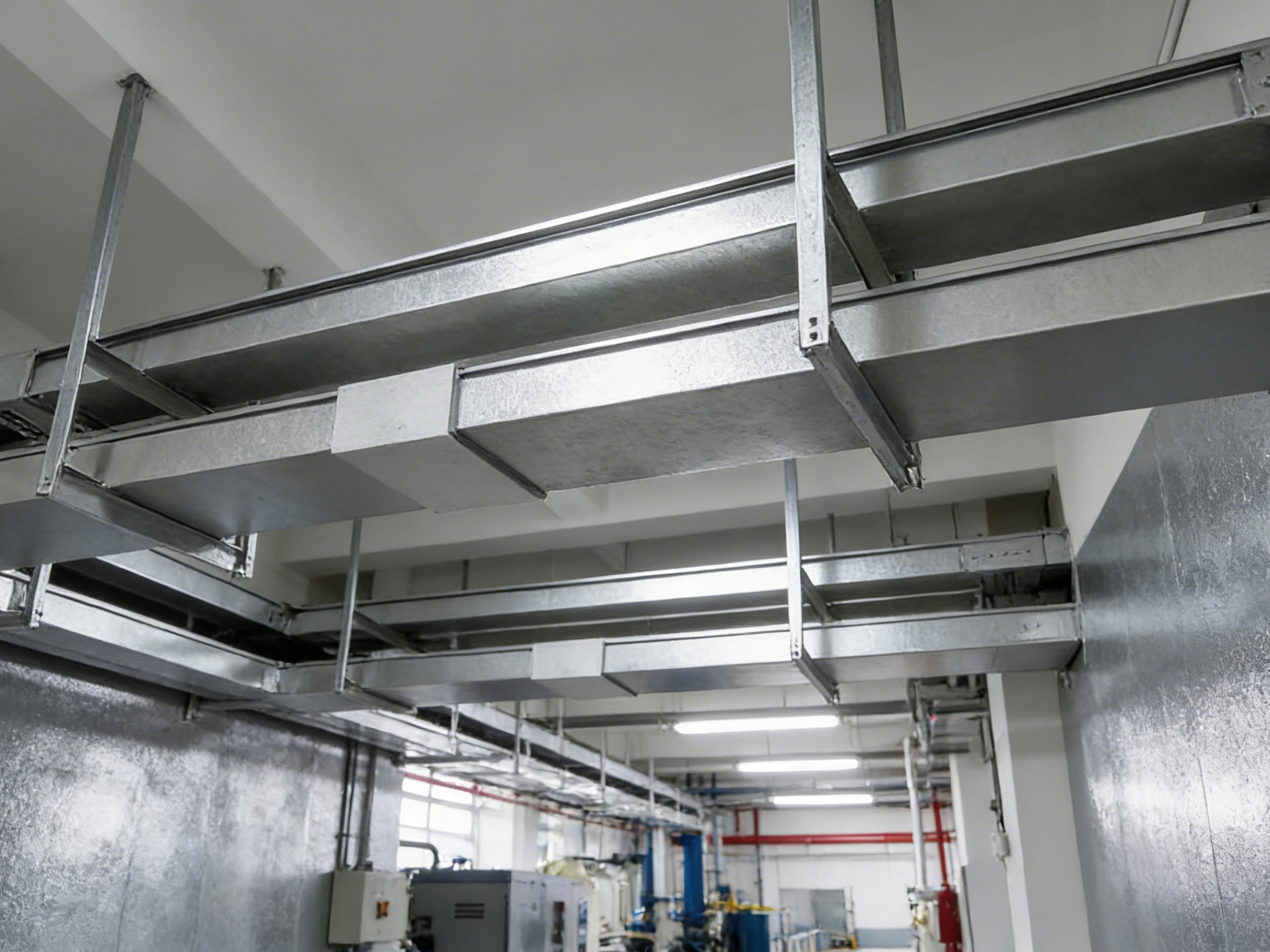
Channel cable trays feature a U-shaped fully enclosed structure, focusing on centralized cable sorting, mechanical damage prevention and neat wiring layout. They are the ideal choice for indoor refined cabling, short-distance cable transmission and building interior electrical systems. BDCABLETRAY recently completed a large-scale cabling renovation project for a comprehensive industrial and office complex. This real engineering case shares the project pain points, customized channel cable tray solutions and practical post-installation benefits.
Project Background & Original Cabling Defects
The client’s project covers office buildings, R&D laboratories and supporting small-scale production workshops. The whole park involves a large number of weak current communication cables, instrument signal lines, lighting power lines and short-distance equipment wiring. The original construction adopted scattered threading pipes and open mesh trays, which exposed many practical problems in daily operation and safety inspection.
Scattered wiring affects overall building aesthetics
The original open-type wiring method leads to exposed cables in ceiling gaps and wall wiring areas. The messy wire layout cannot match the standardized and neat decoration style of office and R&D areas, affecting the overall image of the building and failing high-standard park environment assessment requirements.
Open structure causes frequent cable dust accumulation
Communication and signal cables are very sensitive to dust and humid air. Open mesh trays and exposed threading pipelines cannot block floating dust in the air. Long-term dust accumulation on cable skins easily causes poor heat dissipation, signal instability and accelerated insulation aging, increasing daily maintenance workload.
Lack of mechanical protection for fine signal cables
Laboratory precision instrument cables and weak current signal lines have thin insulation layers and poor impact resistance. The original unprotected wiring method is vulnerable to accidental extrusion and friction during ceiling maintenance and equipment debugging, resulting in local cable damage and intermittent signal failure.
Difficult to maintain and expand later
Traditional threading pipes are fully closed and inconvenient to disassemble, while open trays are messy in wire arrangement. When the office area needs network upgrading, equipment replacement and circuit adjustment, the later cable sorting and expansion work is extremely inefficient, prone to wrong wire connection and circuit confusion.
BDCABLETRAY Custom Channel Cable Tray Solution
Combined with the client’s demands for neat wiring, cable protection, convenient later maintenance and unified building aesthetics, BDCABLETRAY completely replaced the original scattered wiring system with customized high-standard channel cable trays. We adopted targeted structural design and surface treatment for office areas, laboratory areas and workshop auxiliary wiring areas to realize refined, safe and standardized full-park cabling.
Fully enclosed U-shaped structure for comprehensive cable protection
Different from open ladder and mesh trays, BDCABLETRAY channel cable tray adopts integrated U-shaped closed groove design. It completely wraps internal power lines, network lines and instrument signal lines, effectively isolating dust, floating debris and external friction extrusion. It thoroughly solves the problems of easy dust accumulation and vulnerable cables in indoor wiring, and ensures long-term stable signal transmission.
Differentiated surface treatment for different scenarios
For office and laboratory indoor environments with high aesthetic requirements, we adopted electrostatic powder spraying treatment with smooth surface, uniform color and no color difference, matching indoor decoration style perfectly. For workshop auxiliary wiring areas with slight dust and humidity, we used galvanized anti-corrosion channel trays to enhance rust and aging resistance, adapting to long-term industrial indoor operation.
Standard modular splicing for neat layout
All channel trays adopt standardized modular production with precise size tolerance. The butt joint gaps between sections are uniform and flat, and matching elbows, tees and variable-diameter accessories are fully supporting. The overall wiring lines are straight and orderly, realizing unified and standardized wiring layout in the whole park, greatly improving the visual neatness of electrical facilities.
Reserved expansion space for later circuit upgrading
According to the future expansion plan of the park’s office network and laboratory equipment, we reserved reasonable cable space in the channel tray layout. The openable upper cover design facilitates daily cable inspection, line replacement and new circuit access, avoiding the trouble of dismantling a large number of pipelines in later renovation and greatly improving maintenance efficiency.
Lightweight & high-strength structure for indoor ceiling installation
BDCABLETRAY optimizes the plate thickness and structural radian of channel trays, ensuring overall structural rigidity while reducing self-weight. It is very suitable for indoor ceiling and wall-mounted installation, with no pressure on building load. It effectively avoids local deformation and sagging of trays caused by excessive self-weight after long-term cable laying.
Post-Project Operation Effects & Optimization Results
After the overall installation and commissioning of BDCABLETRAY channel cable trays, the client’s park cabling system achieved comprehensive upgrading of safety, aesthetics and practicability. After 18 months of stable operation, all wiring areas are neat and standardized, with zero signal failure and zero cable damage accidents.
In terms of safety performance, the fully enclosed structure completely isolates dust and external mechanical damage. The aging speed of internal cables is significantly reduced, and the stability of office network and laboratory instrument signals is effectively guaranteed, eliminating hidden dangers of circuit short circuit and signal interruption caused by environmental factors.
In terms of on-site management, the unified and orderly channel tray layout completely changes the messy state of exposed cables. The electrical facilities are highly consistent with the overall building style, successfully passing multiple park environmental inspections and safety standardized audits.
In terms of later maintenance, the detachable cover and reserved expansion space make circuit inspection and upgrading more convenient. The maintenance time is shortened by more than 60% compared with the original pipeline wiring, greatly reducing the daily operation and maintenance cost of the park.
Main Application Scenarios of BDCABLETRAY Channel Cable Tray
Office building & commercial indoor wiring
Suitable for office ceiling wiring, wall wiring and shopping mall interior electrical wiring, meeting the dual needs of safe cable protection and high-standard indoor aesthetics.
Laboratory & precision instrument cabling
Ideal for R&D laboratories, testing rooms and precision equipment workshops, protecting weak current signal lines and instrument cables from external interference and damage.
Short-distance equipment transition wiring
Perfect for short-distance cable transition between main tray systems and terminal equipment, replacing traditional threading pipes, with simpler installation and easier later adjustment.
Industrial workshop auxiliary electrical areas
Used for auxiliary lighting, control circuit and weak current wiring in industrial workshops, realizing centralized sorting and safe protection of indoor auxiliary cables.
Core Advantages of BDCABLETRAY Channel Cable Tray
Full enclosed dustproof & anti-interference performance
The integral U-shaped fully enclosed structure effectively prevents dust accumulation and cable exposure, and reduces external electromagnetic interference to weak current signals. It ensures stable operation of communication and instrument circuits for a long time.
Integrated molding with neat appearance & high compatibility
One-piece molding process ensures smooth and flat tray surface without burrs. Various surface color treatments are compatible with different building decoration styles, meeting the high aesthetic requirements of commercial and office buildings.
Easy installation & flexible later expansion
Modular assembly structure simplifies on-site installation procedures. The openable cover design supports free cable inspection, replacement and new line expansion, solving the pain points of difficult maintenance of traditional closed pipelines.
Lightweight structure & strong load stability
Optimized structural design balances lightweight performance and load-bearing capacity. It is not easy to deform or sag after long-term cable laying, adapting to various indoor ceiling and wall-mounted installation environments.
If you need neat, safe and high-aesthetic channel cable tray solutions for office buildings, laboratories and indoor refined cabling projects, contact BDCABLETRAY. Our professional engineering team provides free on-site layout planning, customized color and specification matching, and full-process installation guidance to help you build standardized and low-maintenance indoor cabling systems.
FAQ
1. What is the difference between channel cable tray and ladder cable tray?
Channel cable tray adopts fully enclosed U-shaped structure, focusing on dust prevention, signal protection and neat wiring, suitable for indoor weak current, communication and short-distance wiring. Ladder trays are open and ventilated, mainly used for large-scale power cable laying with high heat dissipation requirements. Channel trays prioritize protection and aesthetics, while ladder trays prioritize heat dissipation and heavy-load bearing.
2. Is channel cable tray suitable for outdoor wiring projects?
Standard channel trays are more suitable for indoor environments such as offices and laboratories. For outdoor open-air and high-corrosion environments, BDCABLETRAY can provide customized hot-dip galvanized or special anti-corrosion treated channel trays to enhance weather resistance and meet outdoor wiring safety standards.
3. Can channel cable trays solve messy indoor cable problems?
Yes. The fully enclosed centralized structure integrates scattered power lines, network lines and signal lines into the tray for unified sorting. The overall layout is flat and orderly, completely avoiding cable exposure and messy winding, greatly improving the standardization and aesthetics of indoor electrical wiring.
4. Is channel tray maintenance more convenient than traditional threading pipes?
Absolutely. Traditional threading pipes are fully sealed and difficult to disassemble, making line inspection and replacement troublesome. BDCABLETRAY channel trays are equipped with detachable top covers, allowing direct access to internal cables for inspection, maintenance and circuit expansion, which greatly improves later operation efficiency.
5. What scenarios are the best fit for channel cable tray installation?
It is the best choice for office buildings, commercial plazas, scientific research laboratories, industrial auxiliary rooms and short-distance equipment transition wiring. It is especially suitable for projects that require both cable safety protection and high-standard indoor environmental aesthetics and standardized management.