



In industrial workshops, commercial buildings and automated equipment rooms, conventional ladder and large-span cable trays often face application limitations. Open ladder trays cannot provide comprehensive protection for fine instrument cables and low-voltage signal lines, while oversized trough trays waste installation space and increase construction costs for short-distance and compact wiring scenarios. For precision control circuits, local equipment wiring and narrow space cabling, professional channel cable trays have become the most cost-effective and standardized solution.
As a U-shaped semi-enclosed cabling carrier, channel cable trays feature compact structure, full-side protection, easy cutting and flexible installation. They perfectly adapt to short-distance point-to-point wiring and narrow-space cable layout scenarios. BDCABLETRAY recently completed a precision electrical renovation project for an automated manufacturing workshop, solving the problems of messy signal wiring, vulnerable cable damage and difficult maintenance with customized channel cable tray systems. This article shares real project pain points, targeted construction schemes and practical operation effects.

Project Background & On-Site Cabling Pain Points
This project is an electrical precision wiring renovation for a fully automated mechanical manufacturing workshop. The workshop is equipped with a large number of PLC control systems, sensor signal lines, equipment communication cables and local low-power power circuits. The original wiring adopted scattered conduit laying and partial open mesh trays, resulting in many practical management and safety problems during long-term equipment operation.
Messy Scattered Wiring Difficult to Maintain
Most precision signal cables and control lines were laid through embedded conduits or random suspension. Once equipment signal failure or circuit aging occurs, the engineering team cannot quickly locate faulty lines. The disordered wiring greatly increases daily troubleshooting and maintenance difficulty, affecting normal production operation efficiency.
Fine Cables Vulnerable to External Damage & Dust Pollution
Open mesh trays and exposed wiring cannot block workshop floating dust, metal debris and minor mechanical friction. Precision instrument cables with thin insulation layers are easily worn, contaminated and damaged. Long-term dust accumulation also affects cable heat dissipation, leading to unstable signal transmission and intermittent equipment failure.
Narrow Installation Space Restricts Traditional Tray Layout
The workshop equipment is densely arranged, with limited wall and gap space. Traditional large-size ladder and trough trays are bulky and difficult to install, while rigid conduit layout lacks flexibility and cannot adapt to equipment position adjustment. The mismatch of wiring carriers leads to irregular overall workshop electrical layout.
High Comprehensive Cost of Traditional Wiring Methods
Conduit laying requires complex cutting, threading and sealing processes with long construction cycles and high labor costs. Open protective trays have insufficient protection performance and need later auxiliary protection transformation, resulting in repeated investment and poor long-term economy.
BDCABLETRAY Custom Channel Cable Tray Solution
Combined with the client’s needs of narrow space layout, precision cable protection and convenient later maintenance, BDCABLETRAY abandoned traditional wiring modes. We adopted standardized hot-dip galvanized channel cable trays, matched with customized size cutting and modular accessories, realizing fully protected, neatly arranged and highly flexible precision cabling for the workshop.
U-Shaped Compact Structure for Narrow Space Adaptation
BDCABLETRAY channel cable tray adopts integrated U-shaped cold-formed structure with narrow and compact size. It is specially designed for short-distance wiring and narrow gap layout between equipment and walls. Compared with bulky traditional trays, it occupies less installation space and can be flexibly laid in equipment gaps, wall edges and top corner areas, making full use of scattered wiring space.
Semi-Enclosed Full Protection for Precision Cables
Different from fully open ladder trays, the channel tray’s semi-enclosed structure provides comprehensive side and bottom protection for internal cables. It effectively isolates workshop dust, metal debris and minor collision friction, preventing precision signal cables from insulation damage and signal interference. Meanwhile, the open top design retains excellent air circulation performance to avoid heat accumulation.
Flexible Cutting & On-Site Modular Installation
Channel cable trays feature simple structure and easy processing. Construction personnel can cut and splice the trays freely according to on-site wiring distances and equipment positions without complex professional tools. Matched with dedicated quick connectors, brackets and bending accessories, the overall construction cycle is greatly shortened, adapting to complex point-to-point wiring paths of automated equipment.
High-Strength Anti-Corrosion Material for Long-Term Stability
All channel trays used in the project adopt thickened hot-dip galvanized steel plate molding. The uniform zinc layer provides reliable anti-rust and anti-corrosion performance, adapting to long-term indoor workshop humid and dust environment. The integral structural strength is stable, capable of bearing medium-density cable bundles without deformation, ensuring long-term safe and stable wiring support.
Classified Zoning Layout for Standardized Wiring
In this project, we adopted partitioned laying according to cable types. Equipment power lines, PLC control lines and sensor signal lines are placed in independent channel trays respectively. The classified layout completely solves the problem of signal disorder caused by mixed wiring, standardizes circuit management and facilitates later line inspection and upgrading.
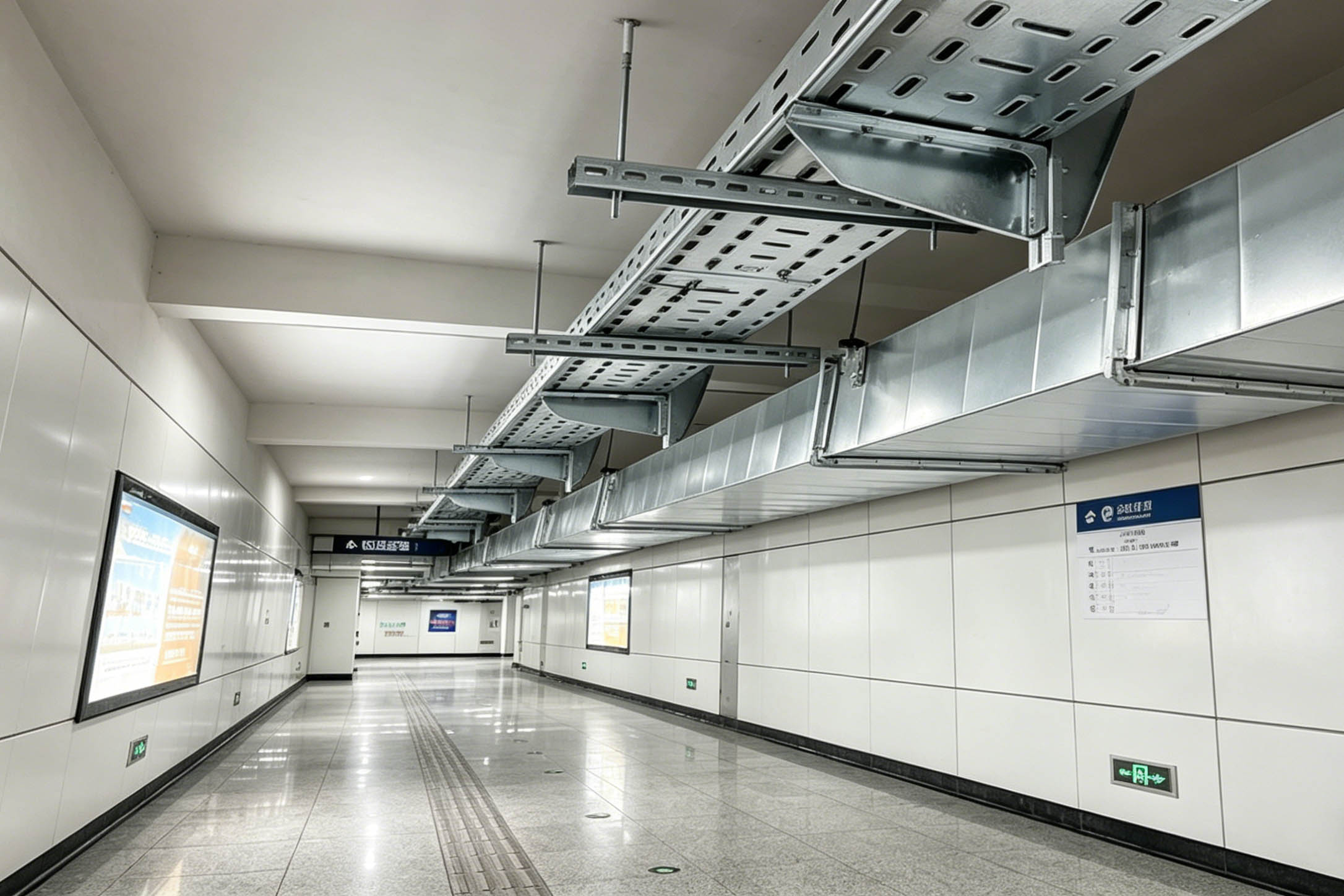
Post-Project Operation Effects & Core Advantages
After the completion of the channel cable tray renovation, the workshop’s internal wiring environment and electrical operation stability have been comprehensively improved. After one year of stable operation, the problems of messy wiring, frequent signal failure and vulnerable cable damage have been completely solved.
The compact channel tray layout makes full use of narrow space resources, realizing neat and uniform overall wiring. The semi-enclosed protective structure keeps internal precision cables clean and intact all year round, eliminating signal interference and equipment misoperation caused by cable pollution and damage. The flexible modular structure also supports free adjustment of wiring paths with equipment upgrading, avoiding repeated wiring transformation.
In addition, the simple installation process greatly saves construction labor costs and shortens the project cycle. The durable anti-corrosion structure reduces daily maintenance frequency, creating safe, stable and cost-saving long-term operation benefits for the enterprise.
Main Application Scenarios of BDCABLETRAY Channel Cable Tray
Automated Workshop Precision Control Wiring
Suitable for PLC control lines, sensor signal cables and equipment communication wiring in intelligent workshops, providing stable protection for precision circuits.
Narrow Space & Local Short-Distance Cabling
Ideal for wall edge wiring, equipment gap layout and short-distance point-to-point wiring where large trays cannot be installed.
Commercial Building Weak Current Systems
Applicable for office network wiring, monitoring lines, building control signal circuits and other weak current precision wiring scenarios.
Industrial Auxiliary Equipment Power Wiring
Used for local power supply wiring of small and medium-sized auxiliary equipment, realizing standardized and neat short-distance power distribution.
Product Core Performance Advantages
Compact Size & Strong Space Adaptability
U-shaped narrow structure adapts to various narrow and limited installation spaces, making up for the layout defects of traditional large-size trays and conduits.
Semi-Enclosed Dual Protection & Heat Dissipation
It takes into account both cable anti-dust and anti-collision protection and open ventilation heat dissipation performance, avoiding heat accumulation while protecting precision circuits.
Easy Processing & Low Construction Cost
Free on-site cutting and splicing, simple installation process, fewer auxiliary accessories required, effectively reducing project labor and time costs.
Durable Anti-Corrosion & Low Maintenance
Hot-dip galvanized anti-rust treatment ensures long-term stable performance in industrial environments, with no frequent maintenance required.
If you need compact, low-cost and fully protected channel cable tray solutions for precision wiring, narrow space cabling and short-distance circuit projects, contact BDCABLETRAY. We provide free on-site wiring evaluation, personalized size customization and professional layout guidance services to help you complete standardized and efficient electrical wiring construction.
FAQ
1. What is a channel cable tray, and how is it different from ladder and trough trays?
Channel cable tray is a U-shaped semi-enclosed cabling carrier with compact size and simple structure. Unlike open ladder trays (focused on heat dissipation for heavy power cables) and fully enclosed trough trays (focused on fire and water prevention), channel trays focus on precision cable protection and narrow-space layout. They are more suitable for short-distance, low-density signal and control wiring, with lower cost and higher flexibility.
2. What scenarios are channel cable trays best used for?
Channel cable trays are ideal for precision weak current wiring and local short-distance cabling scenarios, including automated workshop sensor and PLC signal lines, commercial building network and monitoring wiring, narrow wall gap wiring, and auxiliary equipment local power distribution. They are the optimal choice for space-limited and high-precision circuit protection projects.
3. Can channel cable trays protect precision signal cables from interference?
Yes. BDCABLETRAY channel cable trays adopt standardized metal U-shaped structure, which can form basic electromagnetic shielding effect to reduce external signal interference. Cooperated with classified independent laying of strong and weak current cables, it can effectively avoid crosstalk between circuits and ensure stable and accurate transmission of precision control and signal data.
4. Are channel cable trays easy to install and adjust on site?
Very easy. Compared with complex conduit laying and heavy large-scale tray installation, channel trays feature lightweight body and simple structure. Workers can cut and splice freely according to on-site wiring paths, with flexible matching bending and connecting accessories. The whole construction process is efficient, and later wiring adjustment and expansion will not cause large-scale reconstruction.
5. Can BDCABLETRAY customize channel cable trays for special projects?
Yes. BDCABLETRAY supports full personalized customization of channel cable trays, including different width and height specifications, galvanized, powder-coated and anti-corrosion treatments, and special bending and hole position design. We tailor exclusive compact cabling solutions according to customer on-site space limitations, cable types and construction standards to meet diverse project needs.